

Key Takeaways
- ISO 10218-1:2025 and ISO 10218-2:2025 were published in February 2025, the first major revision of the industrial robot safety standard since 2011 (A3, 2025).
- Most requirements of ISO/TS 15066:2016 on collaborative robots were absorbed into Part 2. “Collaborative” is now a property of the application, not the robot.
- The revision adds robot classifications with matching functional safety requirements, safety-related cybersecurity requirements, and end-effector guidance from ISO/TR 20218-1 and 20218-2.
- The US adoption, ANSI/A3 R15.06-2025, published in September 2025, replaces R15.06-2012 and renames “safety-rated monitored stop” to “monitored standstill” (The Robot Report, 2025).
- ISO 10218 assumes statically stable robots. Dynamically stable legged robots, including humanoids, are addressed by the in-development ISO/WD 25785-1.
ISO 10218 is the core international safety standard for industrial robots, and its 2025 revision is the biggest change to robot safety rules in 14 years. ISO 10218-1:2025 covers the robot itself, ISO 10218-2:2025 covers applications and robot cells, and both were published in February 2025 (A3, 2025). The timing matters: NIOSH reports industrial robot use in US factories grew 10 percent in 2022, while professional service robot sales hit 158,000 units, up 48 percent (NIOSH, 2022 data). More robots means more cells to assess against the new edition. In this article I’ll walk through what changed, how the US and EU adopt the standard, and where humanoids fit. For the full paperwork picture, my robot safety documentation guide covers every required document.
Table of Contents
What Is ISO 10218 and Who Must Comply?
ISO 10218 sets safety requirements for industrial robots and robot systems worldwide. Part 1 addresses robot hardware, Part 2 addresses how that robot is integrated into an application or cell (ISO, 2025). It’s maintained by ISO/TC 299, the robotics technical committee, and the 2025 edition replaced the 2011 edition that had governed robot safety for 14 years.
Who actually has to care? Three groups. Robot manufacturers design to Part 1. Integrators build cells to Part 2. And operators, the companies running the robots, rely on both when they verify that a delivered cell is safe and keep their risk assessments current.
The stakes aren’t theoretical. A NIOSH analysis identified 41 robot-related workplace fatalities in the US between 1992 and 2017, and the underlying study found 78 percent of cases involved a robot striking the worker, with 83 percent involving stationary robots (NIOSH, 2023). Stationary industrial robots, exactly the machines ISO 10218 covers, account for most of the harm.
Standards compliance is voluntary on paper but contractual in practice. Customers, insurers and regulators all treat conformity with ISO 10218 as the baseline evidence that an industrial robot cell is safe.
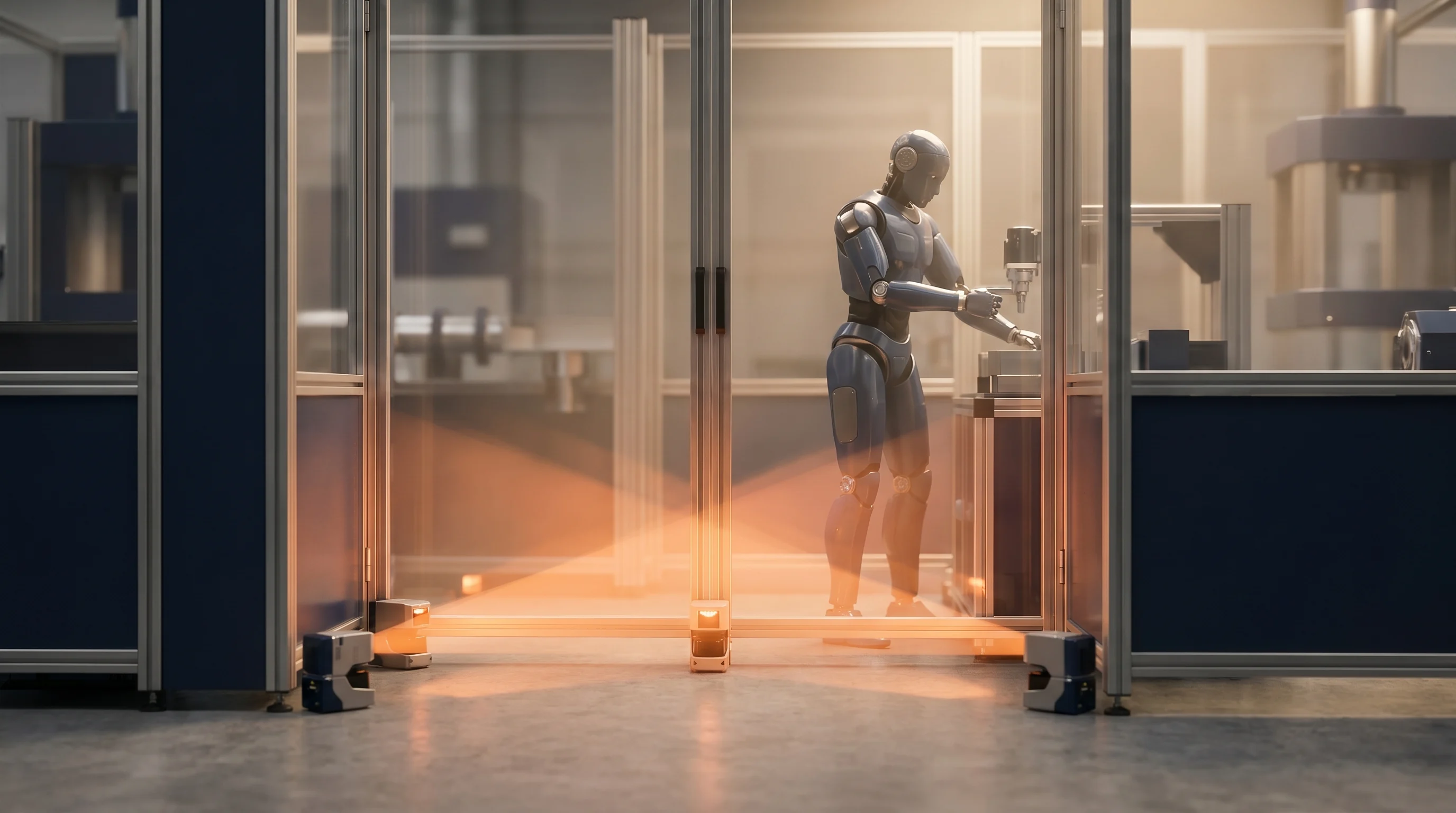
What Changed in the 2025 Revision?
The 2025 revision restructures how collaborative operation is regulated, introduces robot classifications tied to functional safety requirements, adds cybersecurity requirements as they relate to safety, and folds end-effector guidance into the normative text (A3, 2025). It’s a substantial rewrite, not a touch-up. Here’s how I map the changes.
| Area | 2011 Situation | 2025 Change |
|---|---|---|
| Collaborative robots | Basic clauses in ISO 10218, detail added later by ISO/TS 15066:2016 | Most ISO/TS 15066 requirements incorporated into Part 2; collaboration treated as an application property |
| Robot classification | One broad category of industrial robot | New robot classifications with corresponding functional safety requirements |
| Cybersecurity | Not addressed | New cybersecurity requirements as they apply to robot safety |
| End-effectors | Guidance in separate technical reports ISO/TR 20218-1 and 20218-2 | End-effector guidance folded into the standard |
| Document structure | ISO 10218-1:2011 and 10218-2:2011 | ISO 10218-1:2025 (robots) and 10218-2:2025 (applications and cells), published February 2025 |
None of these changes happen in isolation. ISO 10218 still sits on top of ISO 12100:2010, the general risk assessment standard, and works alongside ISO 13849-1:2023 for safety-related control systems (ISO, 2025). If your risk assessment process needs a refresh first, my ISO 12100 risk assessment template for robots walks through that foundation step by step.
Get a free module from the Robot Safety Documentation Toolkit
Enter your email and the 6-page Facility Readiness Checklist lands in your inbox, one complete module from the full toolkit. You also get humanoid robot briefings three times a week. No spam, unsubscribe anytime.
What Happened to ISO/TS 15066 and Collaborative Robots?
The short version: ISO 10218-2:2025 absorbed most of ISO/TS 15066. The ISO 10218-2:2025 abstract states that most requirements of ISO/TS 15066:2016 on collaborative robot applications were incorporated into Part 2 (ISO, 2025). The technical specification that defined power and force limiting and speed and separation monitoring for a decade is now mainstream normative content.
This carries a conceptual shift I think gets underrated. Under the old framing, people bought a “collaborative robot” and assumed safety came in the box. The 2025 edition treats collaboration as a property of the application, not the robot. A power and force limited arm holding a knife-edged gripper isn’t a collaborative application, no matter what the brochure says.
Practically, that means integrators now design collaborative operation under Part 2’s requirements, including the incorporated power and force limiting and speed and separation monitoring provisions. Operators should expect their integrator’s documentation to reference ISO 10218-2:2025 directly rather than the old technical specification. If a vendor quote still cites ISO/TS 15066 as the primary collaborative reference, that’s a sign the paperwork hasn’t caught up with the February 2025 publication.
If you’re updating cell documentation for the 2025 edition, the Robot Safety Documentation Toolkit includes a regulatory overview module that maps ISO 10218:2025 against the EU and US rule sets, plus standards-mapped templates you can adapt to each robot cell. If you would rather find your gaps before buying templates, the ISO 10218:2025 Gap Analysis Checklist ($49) runs your deployment through 62 audit questions in about an hour.
How Does ANSI/A3 R15.06-2025 Adopt It in the US?
The US national adoption is ANSI/A3 R15.06-2025, published in September 2025, replacing ANSI/RIA R15.06-2012 after 13 years (The Robot Report, 2025). Unlike the two-part ISO original, the American standard ships in three parts: Part 1 for industrial robots, Part 2 for robot applications and cells, and Part 3 for the use of industrial robot cells.
Part 3 is the practical difference for operators. It addresses the use of robot cells, which is where day-to-day responsibilities of the companies running robots live, beyond what the manufacturer and integrator deliver.
There’s also a terminology change worth flagging to your safety team: R15.06-2025 replaces “safety-rated monitored stop” with “monitored standstill” (The Robot Report, 2025). Update procedures, HMI labels and training material that use the old term when documents come up for review.
Why does updating matter when ANSI standards are voluntary? Because OSHA enforces the General Duty Clause against recognized hazards, and consensus standards define what “recognized” means. Maximum penalties in 2026 stand at $16,550 per serious violation and $165,514 per willful or repeated violation (OSHA, 2026). Pointing to a standard that R15.06-2025 replaced in September 2025 is an avoidable weakness in any post-incident review.
How Does ISO 10218 Connect to the EU Machinery Regulation?
In Europe, harmonised standards are the practical route to presumption of conformity, and the deadline is fixed. Regulation (EU) 2023/1230, the EU Machinery Regulation, applies from 20 January 2027 and repeals the Machinery Directive 2006/42/EC. A small set of articles has already applied since 20 July 2024 (EUR-Lex, 2023/1230).
Here’s how the pieces connect. The Machinery Regulation defines essential health and safety requirements in law. Standards like ISO 10218 take on legal significance once harmonised under the regulation and cited in the Official Journal. They give manufacturers and integrators a presumption of conformity with those requirements. Designing a robot cell to the current edition of ISO 10218 is therefore the standard path to CE marking for robot machinery in the EU.
For anyone planning new cells, the sequencing is convenient. The 2025 edition of ISO 10218 arrived nearly two years before the regulation’s January 2027 application date. Cells specified today against ISO 10218-1/2:2025 already target the regime that regulators will actually enforce, not the outgoing directive. I’ve broken the wider legal transition down in my EU Machinery Regulation 2023/1230 checklist, including the cybersecurity and documentation duties that catch teams off guard.
The chart below shows how the key dates line up.
Does ISO 10218 Cover Humanoid Robots?
Not fully, and this is the gap every humanoid buyer should understand. ISO 10218 assumes statically stable robots: machines that stay upright when power is cut. A legged humanoid is dynamically stable. It balances actively, and it can become unstable in the absence of power. That failure mode is exactly what the in-development ISO/WD 25785-1 addresses, covering safety requirements for dynamically stable industrial mobile robots with “actively controlled stability” (ISO, working draft).
Meanwhile, humanoids are already on factory floors. Agility Robotics reports its Digit humanoid has moved over 100,000 totes at GXO’s Flowery Branch facility under what the company calls the industry’s first formal Robots-as-a-Service humanoid deployment (Agility Robotics, 2025). At BMW Spartanburg, a Figure 02 humanoid supported production of more than 30,000 BMW X3s over a ten-month pilot, logging about 1,250 operating hours (BMW Group, 2026).
So how are these deployments assessed today? Through general machinery safety law and risk assessment under ISO 12100, applying ISO 10218 concepts by analogy where they fit, until ISO 25785-1 matures into a published standard. I cover that wider patchwork, including the standards beyond ISO 10218, in my overview of humanoid robot safety standards.
What Should Operations Teams Update First?
Start with documentation references, because they’re cheap to fix and expensive to ignore. The National Safety Council puts the cost of US work injuries at $176.5 billion in 2023, with the average medically consulted injury costing $43,000 (NSC, 2023 data). Documentation that cites a superseded standard won’t cause an injury by itself, but it will undermine your defense after one.
My priority order, based on the changes in the 2025 edition:
- Update risk assessments and references. Replace citations of ISO 10218-1/2:2011 and ISO/TS 15066:2016 with the 2025 editions in risk assessments, safety concepts and internal procedures.
- Check integrator and vendor declarations. New quotes and declarations of incorporation or conformity should reference the 2025 editions. Ask vendors directly which edition they design to.
- Map cybersecurity duties. The new safety-related cybersecurity requirements need an owner. Decide who in your organization handles security measures that protect safety functions, and document it.
- Review collaborative applications. Confirm each collaborative cell is assessed as an application under Part 2, not justified by the robot model alone.
- Update terminology in US facilities. Replace “safety-rated monitored stop” with “monitored standstill” in procedures and training as documents come up for review.
Do you need to do all of this in one quarter? No. But cells specified in Europe from now on should be built against the 2025 edition, because they’ll be operating under the Machinery Regulation from 20 January 2027.
To work through this list faster, the Robot Safety Documentation Toolkit bundles a regulatory overview module covering ISO 10218, R15.06 and the EU Machinery Regulation with standards-mapped templates for risk assessments, vendor checks and cell documentation.
Frequently Asked Questions
Is ISO 10218 legally mandatory?
No, ISO standards are voluntary by themselves. They become binding through contracts and through harmonisation under the EU Machinery Regulation 2023/1230 (applying from 20 January 2027). In the US, enforcement context adds pressure: OSHA penalties reach $165,514 per willful or repeated violation in 2026 (OSHA, 2026).
What replaced ISO/TS 15066 for collaborative robots?
ISO 10218-2:2025 absorbed it. The official abstract states that most requirements of ISO/TS 15066:2016 on collaborative robot applications were incorporated into Part 2 (ISO, 2025). Power and force limiting and speed and separation monitoring now live in the main standard, applied to applications rather than robot types.
What is the difference between ISO 10218-1 and ISO 10218-2?
Part 1 covers the industrial robot itself, so it’s primarily a manufacturer obligation. Part 2 covers industrial robot applications and robot cells, so it governs integration: layout, safeguarding, collaborative operation and cell-level verification (ISO, 2025). Operators interact mostly with Part 2 evidence delivered by their integrator.
Do existing robot cells need to be recertified to ISO 10218:2025?
There’s no automatic recertification duty for cells built compliantly under the 2011 edition. The practical trigger points are modifications, new risk assessments and new EU placements on the market, especially once the Machinery Regulation applies from 20 January 2027 (EUR-Lex, 2023/1230). Update references as documents come up for review.
When did the US adopt the new edition?
ANSI/A3 R15.06-2025 was published in September 2025 as a three-part standard, replacing ANSI/RIA R15.06-2012 (The Robot Report, 2025). Part 3, covering the use of industrial robot cells, is new, and the standard replaces “safety-rated monitored stop” with “monitored standstill.”
Where to go next: this procedure is one of six documents every humanoid deployment needs. I map all of them, in the order auditors expect, in the Robot Safety Documentation Guide 2026.
This article is for informational purposes only and does not constitute legal, regulatory or professional safety advice. Obtain the normative text from your national standards body.
Sources
- ISO 10218-1:2025, Robotics, Safety requirements, Part 1: Industrial robots
- ISO 10218-2:2025, Robotics, Safety requirements, Part 2: Industrial robot applications and robot cells
- ISO/WD 25785-1, Safety requirements for dynamically stable industrial mobile robots
- ISO 12100:2010, Safety of machinery, Risk assessment and risk reduction
- ISO 13849-1:2023, Safety-related parts of control systems, Part 1
- ISO/TC 299 Robotics technical committee
- A3 (automate.org): New ANSI/A3 R15.06-2025 American National Standard for Industrial Robot Safety now available
- The Robot Report: Updated ANSI/A3 standards address industrial robot safety (September 12, 2025)
- A3 robot safety standard documents
- Regulation (EU) 2023/1230 on machinery, EUR-Lex
- NIOSH: Robotics in the Workplace, An Overview
- OSHA civil penalty amounts
- National Safety Council, Work Injury Costs
- Agility Robotics: Digit moves over 100,000 totes at GXO
- BMW Group press release: humanoid robots in production in Germany (February 27, 2026)

Ulrich Baldauf is the founder of There’s A Robot For That, covering humanoid robotics for manufacturing and industrial operations. He has tracked the humanoid robot sector since 2024, with a focus on safety standards (ISO 10218, EU Machinery Regulation 2023/1230) and what deployments mean for operations and EHS teams. Connect on LinkedIn: linkedin.com/in/ubaldauf