


In 2024, manufacturers installed 64,542 collaborative robots worldwide. That’s a 12% jump from the year before (IFR World Robotics 2025). Cobots now make up 11.9% of all industrial robot installations, and that share keeps climbing.
Yet for all the buzz, most businesses still don’t have a clear picture. What are cobots, really? What do they cost? Does one make sense for your operation? The term gets thrown around in trade publications and vendor pitches. Often there’s more hype than substance.
This collaborative robots guide cuts through that noise. You’ll learn how cobots work, what types exist, and which applications deliver the strongest ROI. You’ll also see what the updated safety standards mean for your factory floor. Whether you’re a plant manager eyeing your first automation project or an integrator comparing options, everything you need is here.
If you’re already familiar with cobots and want to understand how they compare to humanoid robots, I’ve covered that separately.
Key Takeaways
- Collaborative robots (cobots) represent 11.9% of all industrial robot installations, with 64,542 units deployed in 2024 (IFR World Robotics 2025)
- A complete cobot system costs $40,000-$150,000, a fraction of the $250,000-$500,000+ for traditional robotic cells
- Most deployments pay back in 12-24 months, with high-utilization applications breaking even in under 10 months
- ISO 10218-2:2025 formally absorbed ISO/TS 15066, consolidating all cobot safety requirements into one standard
Table of Contents
What Are Collaborative Robots (Cobots)?
Get a free module from the Robot Safety Documentation Toolkit
Enter your email and the 6-page Facility Readiness Checklist lands in your inbox, one complete module from the full toolkit. You also get humanoid robot briefings three times a week. No spam, unsubscribe anytime.
Collaborative robots, cobots, are robotic arms built to work alongside humans in a shared workspace without safety cages. If you’ve been wondering about the cobot meaning behind the buzzword, it’s straightforward: a robot designed for direct human collaboration. These machines account for 11.9% of all industrial robot installations globally (IFR World Robotics 2025). That share has grown steadily since the concept was first developed at Northwestern University in 1996. Unlike traditional industrial robots locked behind fencing, collaborative robots use built-in sensors to detect contact and stop within milliseconds. They’re lighter, easier to program, and flexible enough to switch between tasks in minutes.
In short, collaborative robots bring automation to workplaces where bulky caged robots simply won’t fit. This section covers the history, core design principles, and key features that set collaborative robots apart.
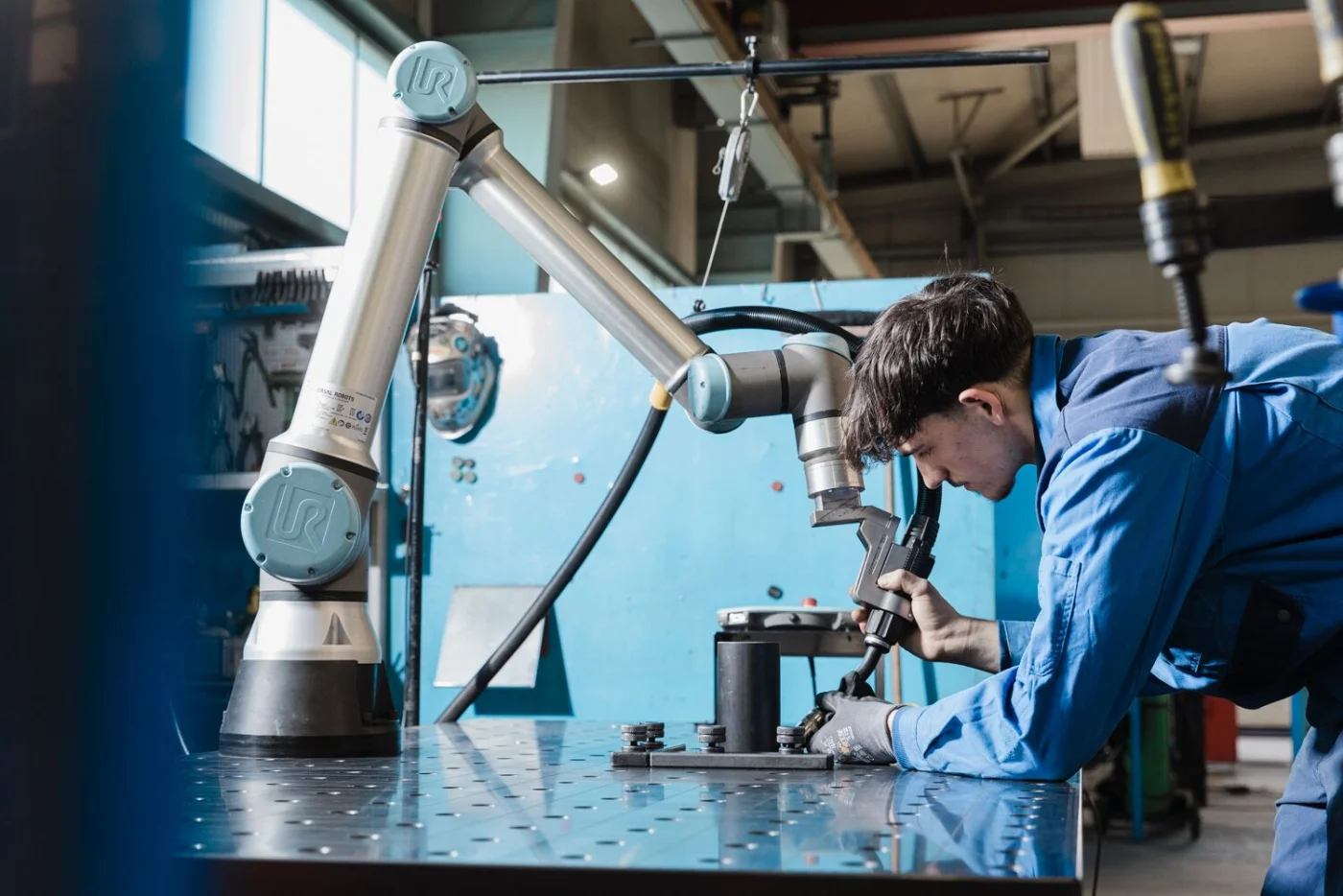
The original idea came from professors J. Edward Colgate and Michael Peshkin. They pictured robots that could physically interact with people during manufacturing tasks. That vision took about two decades to become commercially viable. Still, the core principle hasn’t changed: these machines are built to be safe around humans.
So what makes a robot “collaborative” rather than just small? Three design basics set them apart. If you’ve been searching for cobots explained in plain language, the features below break it down.
Force-Limiting Technology
Every collaborative arm has built-in force and torque sensors. If the arm touches a person, it detects the impact and stops, typically within milliseconds. This force-limiting behavior is what lets these machines operate without the heavy-duty safety fencing that traditional industrial robots require.
Speed and Separation Monitoring
These systems track how close they are to human workers. When someone enters the shared workspace, the robot slows down. Get closer, and it slows further or stops entirely. Move away, and it goes back to normal speed. This dynamic response is part of why they fit into existing production lines so naturally.
Intuitive Programming
Most cobots can be programmed by hand-guiding. You physically move the arm through the path you want, and it learns the motion. No robotics degree needed. Some models also support tablet-based visual programming that non-experts can pick up after a few hours of training.
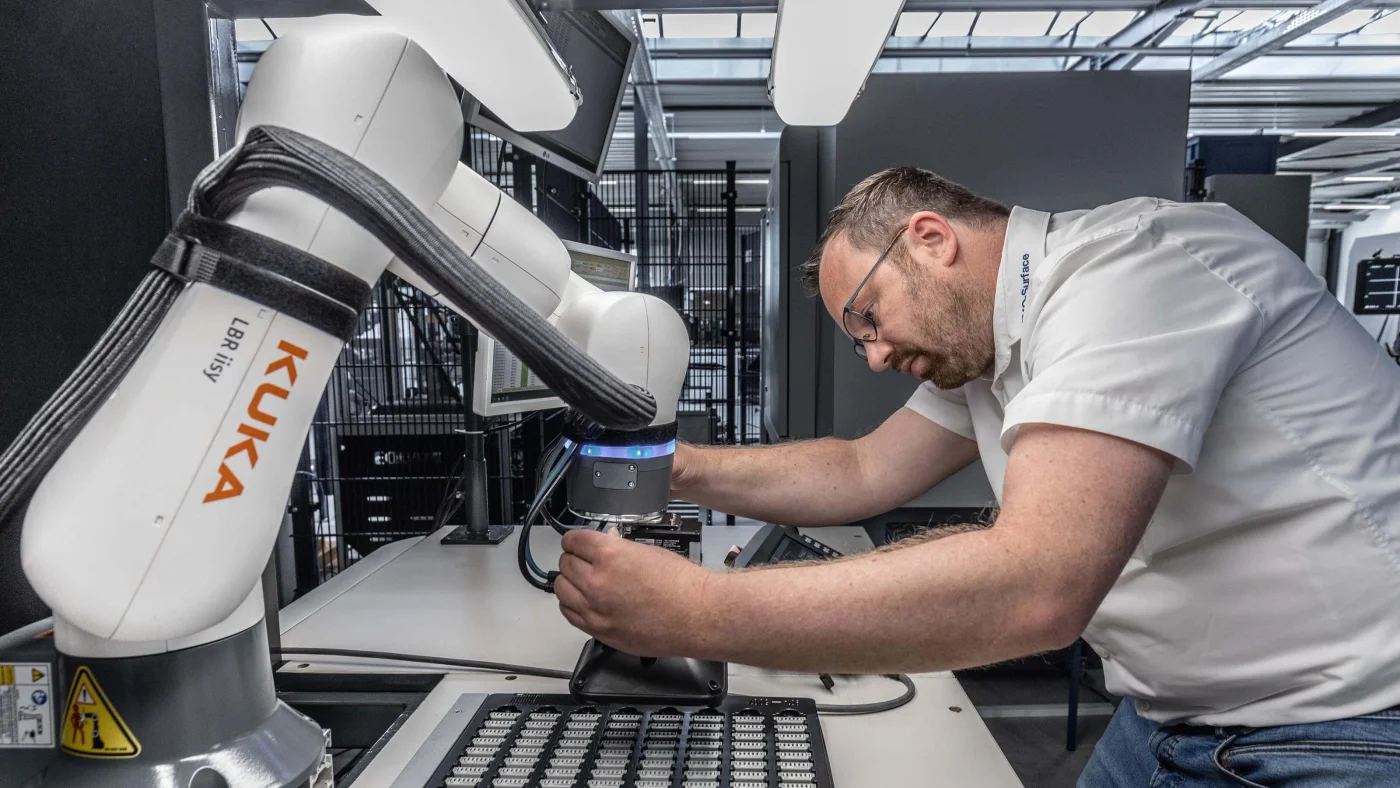
According to the IFR World Robotics 2025 report, 64,542 collaborative robots were installed globally in 2024, up from around 48,000 in 2023, a growth rate that shows no signs of slowing across manufacturing, logistics, and healthcare applications.
Want to understand how cobots stack up against their traditional counterparts? My cobots vs. industrial robots comparison breaks it down head-to-head. And if you’re curious how the newest humanoid robots compare to collaborative arms, I’ve covered that in my humanoids vs. cobots analysis.
How Do Cobots Work?
Collaborative robots rely on built-in force sensors, torque limiters, and real-time collision detection to share workspace safely with humans. Around 90% of robot-related incidents happen during programming and maintenance, not during normal automated operation (PatentPC, 2025). These arms are designed specifically to reduce that risk. They constantly monitor forces at every joint and can stop in a fraction of a second if they touch something unexpected. In practice, this means a worker can stand right next to a moving arm without needing a safety cage.
The technology behind this safe behavior comes down to four collaborative operation modes, which are defined in the ISO/TS 15066 technical specification. Below, each mode is explained how they work together in real deployments.
So how does a collaborative robot that weighs 30+ kilograms avoid hurting someone? It comes down to those four modes.
The Four Collaborative Operation Modes
Safety-rated monitored stop. The robot halts when a person enters the shared workspace. It can hold a part in place while a human works on it. But it doesn’t move until the workspace is clear. Simple, effective, and the most conservative approach.
Hand guiding. An operator physically moves the robot through a task. The arm’s motors provide power assist while the human controls direction and force. This mode is central to how most collaborative arms get programmed.
Speed and separation monitoring. Sensors, often laser scanners and 3D cameras combined, measure the distance between the robot and nearby workers nonstop. The system calculates safe distances in real time. Then it adjusts the robot’s speed to match.
Power and force limiting. This is what most people picture when they think of cobots. The robot’s joints have built-in torque sensors. If contact goes beyond set limits, which are mapped to 29 specific body locations, the arm stops right away. You can literally bump into a force-limited unit, and it’ll feel like a gentle nudge.
In practice, most deployments use several modes at once. A welding arm might use hand guiding for programming, then switch to power and force limiting during production. For a deeper look at how these modes translate into compliance needs, see my guide to cobot safety standards and ISO 15066.
What Types of Cobots Exist?
The collaborative robots market is dominated by lightweight jointed arms, with sub-5 kg payload (the weight a robot can carry) models holding 52.40% of the market. However, the 10-20 kg segment is growing fastest at a 22.95% annual growth rate (Mordor Intelligence, 2025). Knowing the types helps you narrow your search fast. Each design trades off between flexibility, speed, and reach, so there’s no single “best” option. The right choice depends on your task, your workspace, and how much weight you need the arm to handle. The four main categories below you’ll run into when shopping for collaborative robots.
6-Axis Jointed Arms
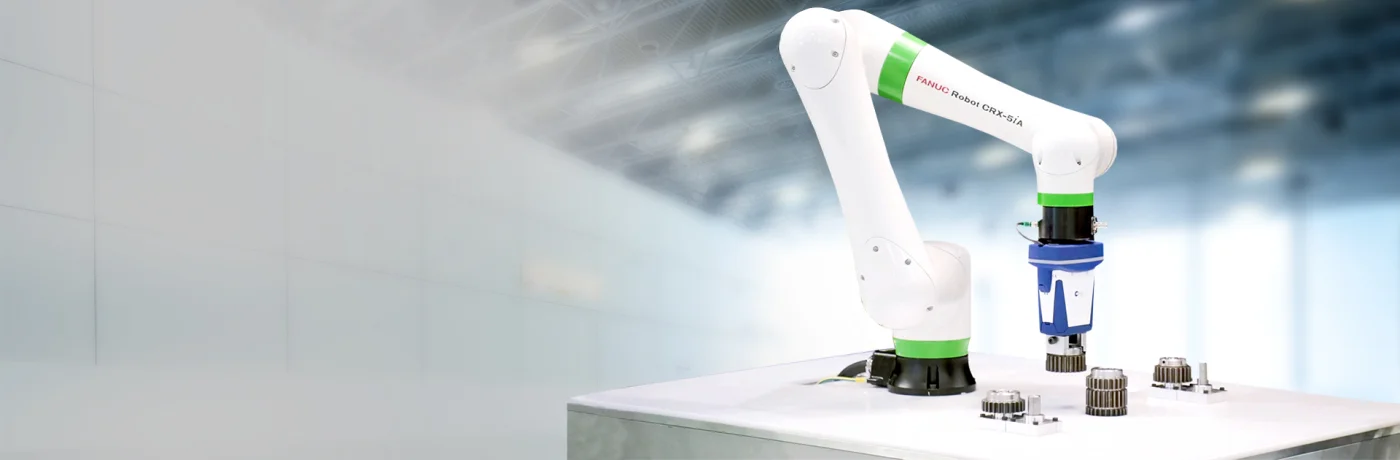
These are the workhorses. Six rotational joints give them human-arm-like flexibility. Universal Robots’ UR series, FANUC’s CRX line, and ABB’s GoFa all fall into this category. Payloads range from 3 kg to 25 kg. They handle everything from assembly to machine tending to welding.
SCARA Cobots
Selective Compliance Articulated Robot Arms excel at fast pick-and-place and insertion tasks. They move along X, Y, and Z axes with a rotational wrist. They’re less flexible than 6-axis arms but faster for flat-plane tasks like circuit board assembly or packaging.
Mobile Cobots (AMR + Arm)
Mount a collaborative robot arm on an autonomous mobile robot, and you get a mobile manipulator. These units can transport materials between stations and perform tasks at each stop. They’re still fairly niche, maybe 5-8% of deployments. Even so, adoption in logistics and large-facility manufacturing is picking up speed.
Delta Cobots
High-speed parallel robots used mainly for light picking and sorting. They’re common in food and pharmaceutical packaging. Not as widespread in the collaborative segment as in traditional automation, but collaborative robot versions are entering the market.
Which type fits your situation? That depends heavily on payload, reach, and task complexity. My cobots vs. industrial robots breakdown explores the selection criteria in more detail.
What Are the Top Cobot Applications?
Assembly tasks generate 25.6% of cobot-related revenue. That makes it the single largest application segment. Meanwhile, palletizing and de-palletizing is growing fastest at a 24.55% annual growth rate through 2031 (Mordor Intelligence, 2025). Why does that matter for your operation? Because the diversity of applications is one reason collaborative robots are spreading so quickly beyond automotive into electronics, food processing, and healthcare. Whether you’re stacking boxes or inspecting circuit boards, there’s likely a proven use case that matches your needs. The six most common applications below and what makes each one worth considering.
Assembly
Collaborative robots handle repetitive assembly steps, inserting screws, pressing components, applying adhesives, with consistent precision. They work especially well in high-mix, low-volume production. In those settings, reprogramming a traditional robot for every product variant isn’t practical. Automotive leads all cobot verticals at 30.35% of market share (Mordor Intelligence, 2025). Assembly is a big reason why.
Machine Tending
Loading and unloading CNC machines, injection molding presses, and stamping equipment. A single arm can tend 2-3 machines at once, running unattended through night shifts. As a result, this is often the first application companies deploy. The ROI case is straightforward.
Welding
Welding suffers from a severe skilled-labor shortage. Collaborative robots don’t replace welders, they multiply them. A single welder can program and oversee multiple welding cells, boosting throughput dramatically. German automotive suppliers using these systems have reported cycle-time cuts of up to 40% (Mordor Intelligence, 2025). For context on how humanoid robots might eventually fit into factory welding lines, that’s a related but separate discussion.
Palletizing
End-of-line stacking and depalletizing. Collaborative robots handle cases weighing up to 20 kg, stacking them onto pallets at the end of production lines. From an ergonomics standpoint, this replaces one of the most injury-prone manual tasks in warehouses and fulfillment centers.
Quality Inspection
Collaborative robots equipped with vision systems perform visual inspection, dimensional measurement, and surface defect detection. They bring cameras and sensors to consistent, repeatable positions. That’s something human inspectors struggle to maintain over eight-hour shifts.
Emerging Applications
Lab automation, surgical assistance, agriculture harvesting, and collaborative sanding/polishing are all growing niches. As grippers and sensors improve, the range of viable tasks will keep expanding.
For detailed case studies and implementation patterns, see my dedicated guide to cobot applications in manufacturing.
How Much Do Cobots Cost in 2026?
A collaborative robot arm alone costs between $25,000 and $60,000. But the total deployed system, including grippers, tooling, integration, and training, typically runs $40,000 to $150,000 (EVS Int, 2026). That’s still far less than traditional robotic cells, which range from $250,000 to over $500,000 (AMD Machines, 2025). Put simply, a collaborative arm can deliver roughly the same output for a fraction of the price. The gap gets even wider once you factor in the shorter setup time and lower integration costs.
For many small and mid-size manufacturers, this price range is what makes collaborative robots realistic for the first time. Here’s how a typical system budget breaks down.
Total Cost Breakdown
The robot arm (40-50% of total cost). This is the arm itself, the jointed arm, controller, and teach pendant. Prices vary by payload and reach. A UR5e with 5 kg payload runs around $35,000. A higher-payload UR20 is closer to $60,000.
Grippers and end-of-arm tooling (15-25%). The gripper, sensor packages, and any custom fixtures. A basic two-finger gripper starts at $3,000-$5,000. Specialized welding torches or vision-guided picking systems can push this well past $15,000.
Integration and programming (15-20%). System design, mounting, wiring, programming, and commissioning. If you’re doing this in-house, costs drop a lot. Using an outside integrator adds $10,000-$30,000 depending on complexity.
Training (5-10%). Operator training, maintenance training, and programming courses. Most manufacturers offer basic training with the purchase. Advanced programming courses run $2,000-$5,000 per person.
Ongoing maintenance (3-5% per year). These arms have fewer moving parts than traditional robots. As a result, they typically need less upkeep. Budget around $1,500-$4,000 per year for preventive maintenance and consumables.
For a full breakdown, see my cobot cost and pricing guide. You can also compare these figures with humanoid robot costs to see how the economics differ.
How Fast Do Cobots Pay for Themselves?
Most collaborative robot deployments pay back in 12 to 24 months. High-utilization setups, two or three shifts per day, break even in under 10 months (AMD Machines, 2025). Annual labor savings per unit range from $27,500 to $97,500, depending on the application and your region’s labor costs. Sound familiar? If you’ve priced out traditional automation for collaborative robots, you know those systems can take three to five years to recoup. Collaborative arms reach payback much faster because they cost less up front and need less integration work, a gap that becomes even clearer next to the numbers in my humanoid robot cost and ROI breakdown. Still, several factors decide whether you’ll land on the fast end or the slow end of that range. The three biggest variables below.
Utilization Is the Biggest Variable
A cobot running one shift produces roughly a third of the value of one running three shifts. Yet the upfront cost is identical. If you can’t keep the arm busy for at least 16 hours a day, the payback period stretches out. This is why machine tending, with its nonstop nature, often delivers the fastest ROI.
Labor Cost Matters More Than You’d Think
In high-wage manufacturing regions (Germany, Japan, parts of the US), one arm replacing a single operator on a repetitive task can save $65,000-$97,500 per year. In lower-cost regions, the savings might be $27,500-$40,000. But here’s the thing, it’s not just about replacing a worker. It’s about redeploying skilled people to higher-value tasks while the machine handles the monotonous stuff.
The Hidden ROI Factors
Fewer ergonomic injuries, lower scrap rates, better consistency, and extended unattended hours all add to returns that don’t show up in simple payback math. I’ve seen operations where the quality boost alone justified the investment, even before counting labor savings. But is that actually true across industries? In my experience, yes, as long as the deployment is well-planned.
For a deeper analysis, see my cobot cost and pricing guide and my recommendations for the best cobots for small businesses.
What Are the Cobot Safety Standards?
In a major 2025 update, ISO 10218-2:2025 (the main robot safety standard) formally absorbed the ISO/TS 15066 technical specification. This change consolidated all collaborative robot safety requirements into a single unified standard (The Robot Report, 2025). It’s a big shift that most industry guides haven’t caught up with yet. Before this merger, manufacturers had to reference two separate documents: ISO 10218 for general robot safety and ISO/TS 15066 for collaborative-specific guidelines. Now, all force limits, speed thresholds, and risk assessment rules for collaborative arms live in one place. For anyone buying, integrating, or certifying collaborative robots, compliance just got simpler.
Here’s what the updated standard covers and what it means in practice, and for the full transition details I’ve written a separate breakdown of the 2025 revision of ISO 10218.
What Does ISO 10218-2:2025 Cover?
The updated standard keeps the four collaborative operation modes (safety-rated monitored stop, hand guiding, speed and separation monitoring, power and force limiting). However, it now provides clearer guidance on how to apply them. It spells out maximum allowed forces and pressures for 29 body locations, from the skull (maximum 130 N transient force) to the fingers (maximum 140 N transient force).
Do Workers Actually Feel Safe Around Cobots?
Data says yes. Around 78% of workers report feeling safer working alongside collaborative arms compared to traditional unguarded automation (PatentPC, 2025). That said, worker confidence depends heavily on proper risk assessment and training. A poorly integrated arm can still cause injuries, even if the forces involved are lower than with a traditional robot.
The Risk Assessment Requirement
Here’s something vendors don’t always stress: buying collaborative robots doesn’t automatically make your application safe. Every deployment requires a documented risk assessment specific to the task, workspace layout, and interaction pattern. The arm’s force-limiting ability is one layer of protection. The system integration, guarding, layout, procedures, is the rest. For a thorough walkthrough, see my cobot safety standards guide and my overview of humanoid robot safety standards.
The Cobot Market in 2026, Where Is It Heading?
The global cobot market was valued at $1.42 billion in 2025. It’s projected to reach $3.38 billion by 2030, growing at an 18.9% annual growth rate (MarketsandMarkets, 2025). Installations are expected to hit roughly 82,000 units in 2026 alone. To put this in context, the collaborative robots market has more than doubled in five years. That kind of growth reflects a real shift in how factories approach automation, moving from large, expensive cells toward smaller, flexible collaborative robots that work alongside people.
Several forces are driving this trend at once. Collaborative robots are compared to traditional compare to traditional ones, who the major players are, and what’s coming next.
Cobots Are Outpacing Traditional Robots
Collaborative robots are growing at over 30% per year in installations. Traditional industrial robots? About 9% (Robotomated / IFR, 2026). The gap is widening, not narrowing. This reflects a basic shift in how manufacturers think about automation, away from massive, capital-heavy cells and toward flexible, human-integrated systems.
Market Leaders and Challengers
Universal Robots holds about 40% market share with over 75,000 units deployed worldwide (Robotomated, 2026). But the field is getting more crowded. FANUC’s CRX series, ABB’s GoFa and SWIFTI, and Doosan Robotics are all gaining ground. On top of that, Chinese manufacturers like AUBO and Jaka are pushing prices down while boosting capability.
What’s Coming Next
For collaborative robots, AI-powered programming is already cutting setup times from hours to minutes. Vision-guided picking without custom fixtures is becoming standard. And the use of large language models for natural-language task instructions is in early deployment at several manufacturers. The collaborative arms of 2028 will look very different from today’s. To see how this trajectory sits alongside the broader shift toward bipedal systems, see my overview of humanoid robots in manufacturing and what early deployments reveal about the next phase of factory automation.
Is a Cobot Right for Your Business?
Not every operation benefits from a collaborative robot. The strongest fit for collaborative robots is a repetitive, low-to-medium payload task in a shared workspace where flexibility matters more than raw speed. In fact, I’ve found that the decision often comes down to just three or four variables. Use the decision matrix below, based on patterns I’ve observed across dozens of deployments, to get a quick read. It’ll help you see whether a collaborative arm or a traditional robot makes more sense for your situation. Beyond that, the best approach to piloting your first unit.
Cobot Decision Matrix
| Factor | Cobot Likely Fits | Traditional Robot Better |
|---|---|---|
| Payload | Under 20 kg | Over 20 kg |
| Workspace | Shared with humans | Dedicated cell available |
| Task variability | Variable, low-volume | Fixed, high-volume |
| Budget | Under $150K total system | Over $250K acceptable |
| Programming | In-house, non-expert staff | Integrator available |
| Cycle time | Flexible, not speed-critical | Sub-second precision needed |
Start Small, Measure, Then Scale
The most successful collaborative robots adopters don’t start with a factory-wide rollout. Instead, they pick one application, usually machine tending or palletizing, deploy a single unit, and measure everything for three to six months. What’s the actual cycle time? How often does it need someone to step in? What’s the real labor offset? For operations considering a longer-term automation roadmap that includes humanoid robots, the humanoid robot manufacturing readiness scorecard helps assess where your facility stands before making that step.
Once you have hard data from a pilot, scaling decisions become straightforward. Your second and third units will deploy in half the time of the first. That’s because your team already knows the workflow.
If you’re a smaller operation wondering where to begin, my guide to the best cobots for small businesses is a good starting point. For a head-to-head technology comparison, see cobots vs. industrial robots.
Frequently Asked Questions
What is the difference between a cobot and a robot?
The main difference is safety design. Cobots have built-in force-limiting sensors, torque monitoring, and collision detection. These features let them work beside humans without safety cages. Traditional industrial robots run at full speed and force inside guarded cells. Collaborative robots handle payloads up to about 25 kg. Industrial robots can manage hundreds of kilograms. For a detailed comparison, see my cobots vs. industrial robots guide.
Are cobots safe?
Yes, when properly set up. Collaborative robots comply with ISO 10218-2:2025 (which now includes the former ISO/TS 15066 requirements). The standard spells out force limits for 29 body locations. About 78% of workers report feeling safer with collaborative robots than with traditional unguarded automation (PatentPC, 2025). However, every deployment still requires a task-specific risk assessment. Learn more in my cobot safety standards guide.
How much does a cobot cost?
An arm alone costs $25,000-$60,000. A fully deployed system, including grippers, integration, and training, typically runs $40,000-$150,000 (EVS Int, 2026). That’s roughly one-quarter to one-third the cost of a traditional robotic cell at $250,000-$500,000+. Get the full breakdown in my cobot cost and pricing guide.
How long until a cobot pays for itself?
Most deployments pay back within 12 to 24 months. High-utilization setups running two or three shifts can break even in under 10 months (AMD Machines, 2025). Annual labor savings range from $27,500 to $97,500 per unit, depending on the application and regional labor costs.
Can cobots work without safety fencing?
Yes, that’s one of their core design advantages. These machines are built to operate in shared human-robot workspaces without safety cages. They rely on force-limiting joints and collision-detection systems. However, “no fencing required” doesn’t mean “no safety measures needed.” Every application requires a documented risk assessment, and my guide to robot safety documentation shows exactly what that paperwork needs to contain. Some high-speed or sharp-tooling setups may still need light curtains or area scanners as extra protection layers.
Sources
- IFR World Robotics 2025. https://ifr.org/ifr-press-releases/news/global-robot-demand-in-factories-doubles-over-10-years
- PatentPC. https://patentpc.com/blog/collaborative-robot-safety-stats-incidents-prevention
- Mordor Intelligence. https://www.mordorintelligence.com/industry-reports/collaborative-robot-market
- EVS Int. https://www.evsint.com/how-much-does-a-cobot-cost-pricing-guide-2026/
- AMD Machines. https://amdmachines.com/blog/cobot-payback-period/
- The Robot Report. https://www.therobotreport.com/iso-10218-industrial-robot-safety-standard-receives-major-overhaul/
- MarketsandMarkets. https://www.marketsandmarkets.com/PressReleases/collaborative-robot.asp
- Robotomated. https://robotomated.com/learn/market/cobot-adoption-manufacturing-2026

Ulrich Baldauf is the founder of There’s A Robot For That, covering humanoid robotics for manufacturing and industrial operations. He has tracked the humanoid robot sector since 2024, with a focus on safety standards (ISO 10218, EU Machinery Regulation 2023/1230) and what deployments mean for operations and EHS teams. Connect on LinkedIn: linkedin.com/in/ubaldauf