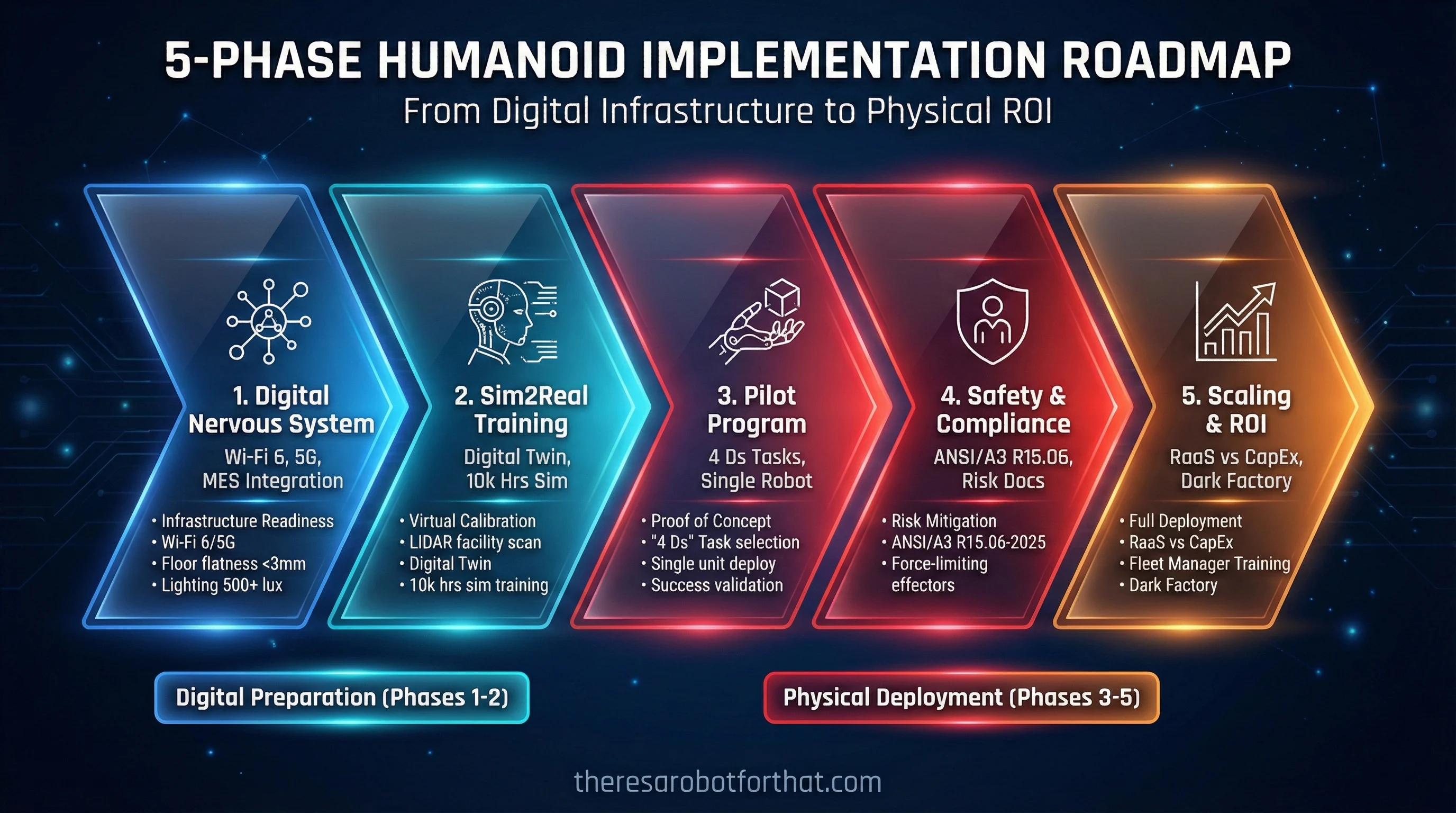
A successful humanoid robot implementation guide requires five phases: assessment, simulation, pilot, compliance, and scaling.
MES integration enables real-time robot telemetry
Sim2Real training compresses months of learning into hours
ANSI/A3 R15.06-2025 compliance is legally mandatory
Manufacturers worldwide installed 542,000 industrial robots in 2024, according to the IFR World Robotics 2025 report, with installations expected to reach 575,000 units in 2025. Humanoid models are the fastest-growing segment. Figure 02 logged 1,250 hours at BMW’s Spartanburg plant and moved over 90,000 components. Agility Robotics Digit moved from pilot programs to production deployments at Amazon and Toyota Canada. This humanoid robot implementation guide covers the five-phase deployment process that these manufacturers follow, from systems check to full-scale operations.
Key Takeaways
Key Takeaways
The question for CTOs and plant managers shifted from “if” to “how.” Every humanoid robot implementation guide starts with the same five phases: Assessment, Simulation, Pilot, Compliance, and Scale. You need a roadmap that covers systems setup, staff training, safety checks, and ROI across each one.
Image Source: Gemini / There’s A Robot For That
Each phase in this humanoid robot implementation guide has specific requirements and a typical timeline. Phase 1 takes 4-8 weeks. Phase 2 takes 2-4 weeks. Phase 3 runs 8-12 weeks. Phase 4 overlaps with Phase 3 at 4-6 weeks. Phase 5 scales over 3-6 months. Skip a phase and the pilot fails. Before starting, run through my 2026 manufacturing readiness assessment to confirm your facility meets the baseline requirements for each phase.
What Does Your Factory Need for Humanoid Robot Implementation?
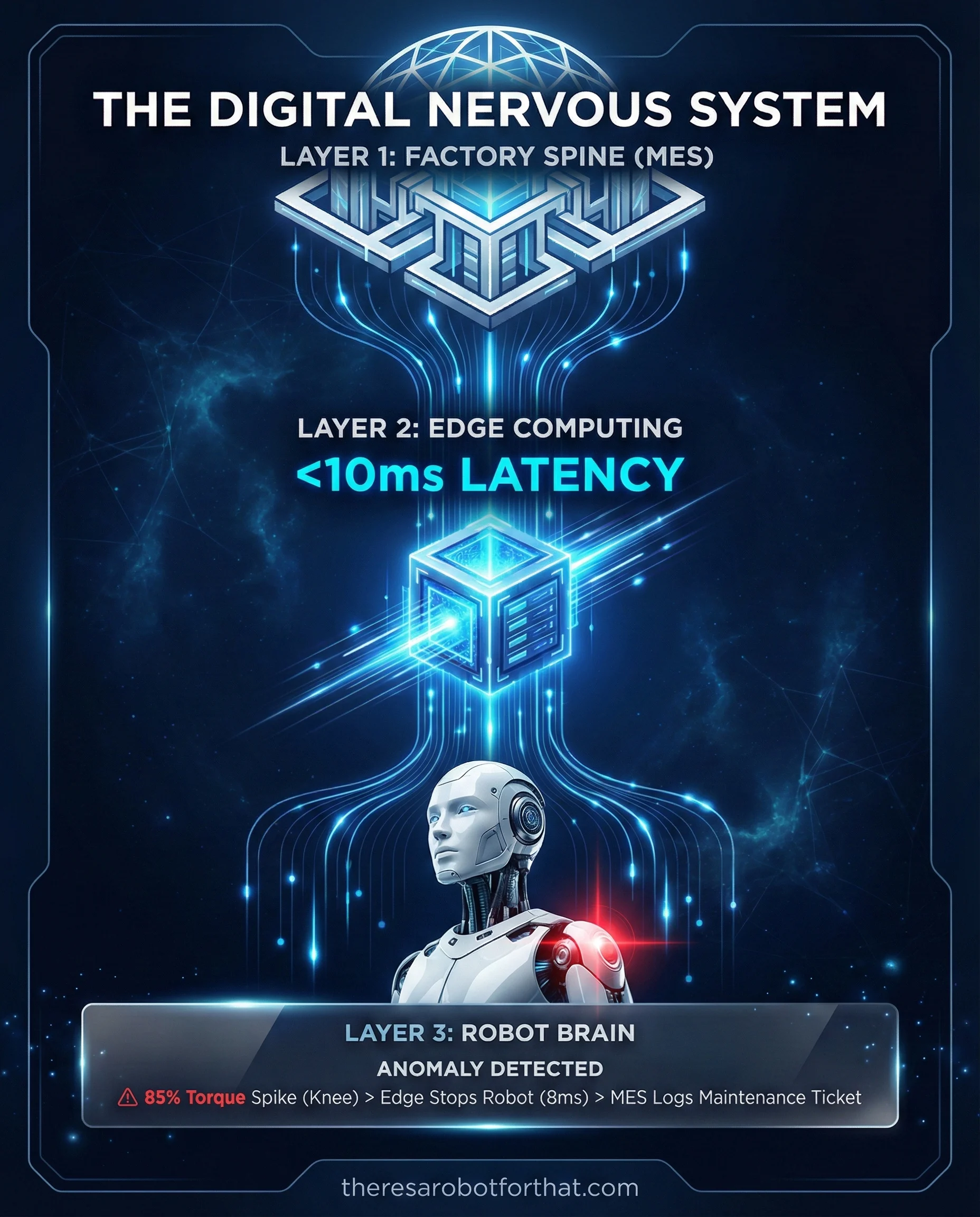
The “Digital Nervous System” connects three layers: the onboard AI, local edge nodes, and your factory’s MES software. Without these connections, humanoid units become expensive mannequins that can’t talk to your production systems. “Plug and play” is a myth. Each unit needs to know where it is, what it’s carrying, and what comes next, and that data flows through all three layers in real time.
Image Source: Gemini / There’s A Robot For That
Here is what that looks like in practice: a tote-moving unit stops mid-aisle because its knee joint reports 85% torque. The edge node flags the anomaly, the MES logs the location, and your maintenance crew discovers oil residue on the floor. You fix the spill before the joint fails. That is the Digital Nervous System working.
Site Readiness Checklist
Before a robot arrives, your facility needs these key elements in place:
Wi-Fi 6 or 5G coverage: No dead zones. Robots transmit telemetry every 100 milliseconds. A coverage gap means the unit stops or operates blind.
Floor flatness within 3mm variance: Bipedal robots balance differently than wheeled AGVs. Expansion joints, oil residue, and uneven epoxy coatings cause balance failures. Measure your floor with a profilometer (a surface flatness gauge), don’t guess. Floor conditions directly impact fall zone calculations under emerging safety standards.
Consistent lighting at 500+ lux: Vision systems need stable illumination. Shadows from overhead cranes confuse object detection. Install extra LED panels in work zones.
Edge computing nodes within 50 meters: Cloud latency kills real-time decisions. Local compute handles navigation and manipulation. According to NVIDIA’s robotics infrastructure guidelines, edge nodes reduce decision latency from 200ms to under 10ms.
MES integration API access: Your system needs to pull work orders and push completion data. If your MES is a black box, the robot can’t integrate. Budget for middleware if necessary.
Your factory is 40 years old. Aisles built for humans, not machines. Traditional automation wants you to rip out the floor. Industrial humanoids walk through the door you already have. But they need the nervous system in place first.
Battery life and endurance matter for multi-shift operations. Recent battery life and endurance benchmarks show that modern humanoids can operate for extended periods, but charging infrastructure must be planned into your facility layout.
How Does Sim2Real Training Prepare Your Robots?
According to NVIDIA Robotics, engineers can compress months of training into just hours of compute time. Sim2Real workflows use tools like NVIDIA Isaac to build a digital copy of your factory. Robots train on thousands of tasks in this virtual space before they ever touch real hardware.
By contrast, physical training is expensive. When a unit collides with a pallet, downtime costs $500 per hour, and the hardware needs recalibration. Multiply that by 1,000 learning iterations, and the cost becomes clear. Simulation removes that risk entirely.
The Sim2Real workflow has three steps:
1. Scan your facility. Use LIDAR to capture every aisle width, shelf height, and floor texture. The digital twin must match reality within centimeters because inaccurate scans produce policies that fail on transfer.
2. Train the policy in simulation. The unit navigates the virtual factory, picks virtual totes, and handles virtual obstacles like forklifts blocking an aisle, pallets placed out of position, or a worker crossing its path. You run millions of variations, and the AI learns to handle each one safely in software.
3. Transfer the trained policy to hardware. Finally, the validated policy loads onto the physical unit, which already “knows” your facility. First-day success rates jump from 60% to 95% or higher with Sim2Real pre-training.
As a result, Sim2Real is Step 0, not optional. In case studies from six US factories, every successful pilot used simulation first. Skipping it means the unit encounters a scenario it never trained for, stops cold, and your operators lose confidence. Simulation also reveals problems before hardware arrives. For example, your digital twin might show a Wi-Fi dead zone in aisle 7 that you can fix before the first unit ever rolls out.
How Should You Structure a Humanoid Robot Pilot Program?
Successful pilot programs focus on the “4 Ds” (Dull, Dirty, Dangerous, Dear) tasks, as BMW and Amazon have shown. These jobs have high repetition and low variability, which makes them ideal for machines learning factory workflows. For this reason, select a task where failure doesn’t halt production, such as tote transport rather than final assembly. Your team builds confidence on non-critical paths first, then you scale to higher-value work.
Case Study: Amazon & Agility Robotics Digit
Task: Moving empty totes from processing stations to staging areas, a high-volume, low-variability job.
Setup: Amazon deployed Digit in a Seattle fulfillment center. Digit navigates human-populated aisles. It identifies empty totes via computer vision, picks them up, carries them, and stacks them in set zones.
Results: According to Agility Robotics, the trial achieved a 98% success rate at $10-12 per hour under Robot-as-a-Service pricing, compared to $30 or more per hour for fully burdened human labor. Digit moved 400 totes per shift while human workers were reassigned to exception handling and quality control.
Case Study: BMW & Figure 02
Task: Sheet metal insertion for door panel assembly.
Setup: BMW deployed the Figure 02 robot at its Spartanburg, South Carolina plant. The robot picks sheet metal blanks from a cart. It inserts them into a stamping press with sub-millimeter precision. The task requires force feedback and real-time adjustment.
Results: According to Fortune, Figure 02 logged 1,250 hours and moved over 90,000 components at BMW Spartanburg. The robot performed one task, picking up sheet metal parts and placing them on a welding fixture, for ten months straight. It achieved consistent precision insertion with a 99% per-shift success rate, matching or exceeding human capability on this task. The job needed before two workers per shift; now one worker supervises three machines. BMW chose this task because the success metric is binary: either the part fits or it doesn’t. For more on Figure 02 and F.03 developments, see the latest updates on next-generation capabilities.
Since the Amazon pilot, Digit has expanded to automotive manufacturing. According to Canadian Metalworking, Toyota Motor Manufacturing Canada (TMMC) deployed seven Digit units at its Woodstock, Ontario facility. The robots feed totes of automotive parts to assembly lines, loading and unloading automated tuggers. Digit uses AI to recognize tote shapes and adjust its grip accordingly.
In all three cases, the pilots started small. Any practical humanoid robot implementation guide will tell you the same thing: Amazon didn’t deploy 100 units on day one, BMW didn’t hand over final assembly, and Toyota Canada started with three units before scaling to seven. They chose bounded jobs with clear success metrics, and success built the momentum needed to scale.
According to the A3 Association for Advancing Automation, the ANSI/A3 R15.06-2025 standard is now the legal baseline for fenceless robot work in the US. It covers force limits on robot hands, security rules for connected systems, and risk checks for walking robots. For a full breakdown of ISO 10218, ISO 25785-1, and OSHA rules, see my guide to humanoid robot safety standards in 2026.
Older rules assumed machines worked behind fences while humans stayed out. However, humanoid units work right beside people, which creates different risks that need entirely different rules.
Key Updates in ANSI/A3 R15.06-2025
Speed and separation monitoring: The unit must maintain minimum distances from humans, and if a worker enters the zone it slows or stops within 200 milliseconds. Force-limiting end-effectors: Grippers and hands must cap contact force at 150 newtons for brief contact and 75 newtons for sustained contact, which prevents injury during accidental collisions.
Cybersecurity protocols: Connected units are network endpoints, so the standard requires encrypted telemetry, authenticated command channels, and intrusion detection because a compromised machine is a safety hazard. Risk assessment for bipedal locomotion: Walking systems have different failure modes than wheeled platforms. A balance failure can send the unit falling toward a worker, which is why the standard mandates fall-path analysis and emergency stop systems.
In practice, fenceless operation is not optional safety theater. It’s a legal requirement. Inspectors will audit your deployment. Non-compliance means shutdown and fines. The fastest way to be ready is a prepared robot safety documentation toolkit that covers the ISO 10218 risk assessments and records auditors check.
⚠️
Warning: Compliance is Non-Negotiable
Deploying a humanoid robot without ANSI/A3 R15.06-2025 compliance exposes your company to liability. If a robot injures a worker and you lack documented risk assessments, you face regulatory action and lawsuits. Budget for compliance engineering before pilot launch.
Compliance requires documented risk assessments for every task and zone in your facility, and I keep all of mine organized using the system I outline in my robot safety documentation guide.
In our analysis of the ANSI/A3 R15.06-2025 documentation, three compliance areas trip up most first-time deployers, and I work through each one using my ISO 12100 risk assessment template before any unit ships. The standard also distinguishes between collaborative zones and restricted zones. Collaborative zones allow human-robot interaction. Restricted zones are robot-only during operation. Your facility layout must clearly mark both.
What ROI Can You Expect from Humanoid Robots?
Humanoid robots like Digit cost $10-12 per hour to operate under RaaS pricing. That’s roughly a third of the $30/hour average for US warehouse workers. However, the full ROI picture goes beyond hourly rates. You also need to factor in capital costs, training, and workforce changes.
CapEx vs. Robot-as-a-Service (RaaS)
Outright purchase: A humanoid robot costs $30,000-$150,000 depending on capabilities. You own the hardware. You handle maintenance. You absorb obsolescence risk. Depreciation schedules run 5-7 years.
RaaS model: You pay $10-12 per operating hour. The vendor handles maintenance, software updates, and hardware swaps. No upfront capital. You scale up or down based on demand. Mid-market manufacturers prefer this model because it converts CapEx to OpEx.
So which model makes more financial sense for your operation? This math shows up consistently in published pilot data. For a full breakdown of all cost components across both CapEx and RaaS models, see my humanoid robot cost and ROI breakdown. The break-even point depends on utilization. A single unit running two shifts per day (16 hours) costs $192 per day under RaaS. That’s $70,080 per year. Human labor for the same hours costs $140,160 at $30/hour. You save $70,080 annually per position.
But the calculation changes if the unit only runs one shift. Utilization below 50% makes RaaS more expensive than human labor. Plan your task allocation carefully.
Cost Element
Human Labor
RaaS Model (Digit)
Hourly rate
$30
$10-12
Annual cost (2 shifts)
$140,160
$70,080
Benefits/overhead
Included in rate
Included in rate
Training cost
$2,000-5,000/year
Included
Turnover cost
$4,000-8,000/replacement
Zero
Annual cost comparison for a single robot position running two 8-hour shifts per day.
Workforce Transition: Operator to Fleet Manager
Your workers don’t disappear. Instead, they evolve. The “Operator” becomes a “Fleet Manager” who supervises three to five units, handling exceptions when a machine encounters an unexpected obstacle, a sensor flags an issue, or a situation needs human judgment. This shift requires 40-80 hours of training per fleet manager covering telemetry reading, basic troubleshooting, and escalation protocols, which I structure around the robot safety training and competency system I built for my own deployments. The investment pays off in faster issue fixes and higher uptime.
Eventually, some facilities reach “Dark Factory” status: fully automated shifts with no human workers on the floor. Lights stay off to save energy. The systems run 24/7 while humans monitor remotely. This is the end state for high-volume, low-variability production. But it takes years, not months.
For insights on scaling robot fleets, see how large-scale deployments are structured.
Which Humanoid Robot Fits Your Factory in 2026?
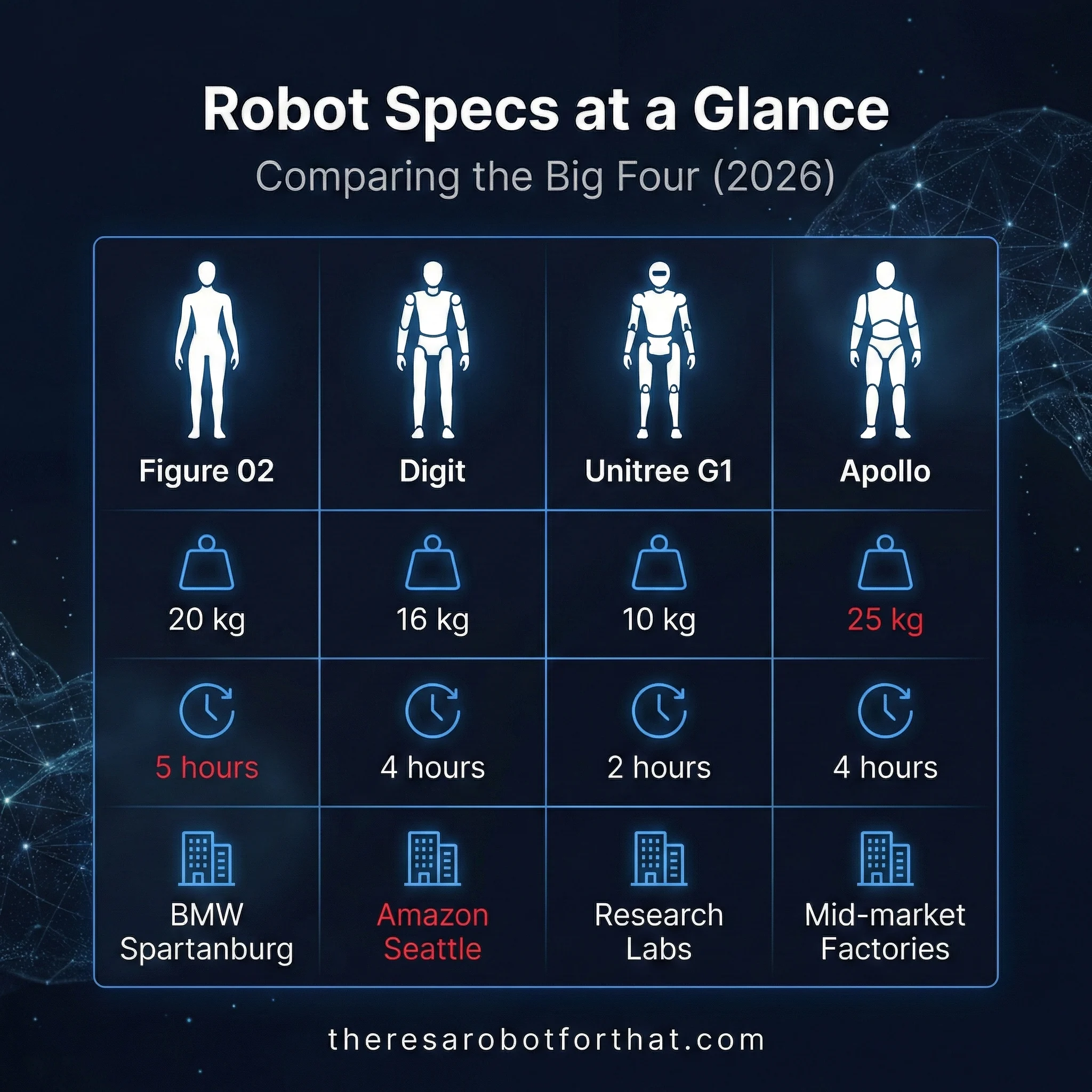
Four humanoid robots lead the factory floor in 2026: Figure 02, Digit, Unitree G1, and Apollo. Each fits different tasks. Your choice depends on what you need to move, how long you need it running, and what your facility looks like.
Image Source: Gemini / There’s A Robot For That Payload and battery life comparison for leading industrial humanoid robots.
Model
Manufacturer
Payload
Battery Life
Best For
Figure 02
Figure AI
20 kg
5 hours
Automotive assembly, precision insertion
Digit
Agility Robotics
16 kg
4 hours
Logistics, tote handling, warehouse
Unitree G1
Unitree Robotics
10 kg
2 hours
Research, general purpose, flexible tasks
Apollo
Apptronik
25 kg
4 hours
General manufacturing, material handling
Figure 02 excels at precision tasks. Its dexterous hands and force feedback enable sub-millimeter accuracy. BMW uses it for sheet metal work. If your task requires tight tolerances, Figure 02 is the choice.
Digit dominates logistics. Its design prioritizes stability and payload over dexterity. Amazon deploys it for tote transport. If your task is “pick and carry,” Digit delivers proven results.
Unitree G1 serves as a flexible platform. It’s less specialized but more adaptable. Research facilities and pilot programs favor it. For more on Unitree G1 capabilities, see the expanding software ecosystem.
Apollo targets general manufacturing. Its higher payload capacity of 55 lbs suits heavier parts. According to EE Times, Apollo has been trialed on manufacturing lines at Mercedes-Benz’s Digital Factory Campus in Berlin and at Jabil facilities. Apptronik positions it as a “universal worker” for mid-market factories, using Gemini multimodal reasoning for vision-language-action control.
Two more contenders arrive soon. Boston Dynamics Atlas enters production in 2028, with Hyundai planning to deploy 25,000 units and targeting 30,000 units annual production capacity. 1X Technologies’ Neo costs $20,000 per unit, booked 10,000 pre-orders in five days, and began full-scale production at its Hayward, California factory in 2026.
The market reflects this momentum. Yole Group projects a 56% CAGR for the humanoid robot market, reaching $6 billion by 2030 and potentially $51 billion by 2035. No single model fits every job. Match the robot’s strengths to your task requirements. Precision work needs Figure 02. High-volume logistics needs Digit. Flexibility needs Unitree G1.
How Do Workers React to Humanoid Robots on the Factory Floor?
Your pilot will succeed or fail based on one factor: do your workers accept the robot? In our review of published case studies, floor teams react with a mix of curiosity and worry when a 1.7-meter robot starts working next to them.
The human-like shape triggers responses that wheeled machines don’t. People read intent into a walking figure, and a humanoid that stops while facing you feels more threatening than a wheeled unit with a sensor glitch. Successful rollouts address this head-on by communicating early, letting workers control the system via teleoperation, and showing them it handles dull, dirty, and dangerous tasks so their jobs evolve rather than disappear.
One BMW worker described the Figure 02 as “the new guy who never complains about overtime.” That framing worked because the machine wasn’t replacing him; it was taking the repetitive work he disliked, and he moved to quality inspection with more variety and higher pay. Transparency builds trust: show workers the system’s sensor view, explain how it makes decisions, and invite feedback on task design. Workers who feel heard become advocates, while workers who feel threatened become obstacles.
What Are the Most Common Humanoid Robot Deployment Mistakes?
According to deployment reports from BMW and Amazon, most pilot failures trace back to five common mistakes. I cover each one in detail in my post on humanoid robot deployment mistakes to avoid. Here’s what to avoid.
Choosing tasks too complex for day one. Start with tote transport, not multi-step assembly. Build confidence with simple, high-volume jobs first. Underestimating floor quality. Uneven joints and debris trip bipedal systems. Measure friction with a profilometer (a surface flatness gauge) rather than guessing. A $200 measurement saves a $50,000 pilot. For current pricing and availability, see our humanoid robots for sale buyers guide.
IT blocking cloud access late. These systems need cloud access for software updates, so engage IT in Phase 1, not Phase 3. Skipping Sim2Real training. Physical-only training costs 10x more and takes 10x longer; simulation is the foundation, not an optional step. Ignoring ANSI/A3 R15.06-2025 compliance. Non-compliance means legal liability, so budget for risk assessments and safety engineering before the pilot starts.
When Should You Choose Alternatives to Humanoid Robots?
Current humanoid models handle payloads up to 25 kg and run for 2-5 hours per charge. They aren’t the answer for every task. High-speed assembly lines exceed their cycle times, delicate electronics exceed their dexterity, and outdoor environments with mud and rain exceed their environmental ratings. These are part of the broader challenges blocking humanoid production readiness that every plant manager should understand before budgeting a pilot. How do you know when a humanoid is the wrong choice? Here is when you should consider alternatives:
Cycle times under 5 seconds: Traditional industrial arms are faster; bipedal systems can’t match a dedicated pick-and-place line. Extreme precision under 0.01mm: Specialized CNC and robotic arms still offer better accuracy, though humanoids are closing the gap.
Outdoor or harsh environments: Most humanoid models are rated for indoor use only, and dust, water, or temperature extremes cause failures. Heavy lifting over 30 kg: Current models max out around 25 kg payload, so heavier loads still need traditional material handling gear.
As an alternative, consider wheeled AMRs for pure transport jobs and collaborative arms for fixed-position assembly. No humanoid robot implementation guide would recommend humanoids for every job. Choose a humanoid when the work requires human-like mobility and manipulation in spaces designed for people.
Your 5-Phase Humanoid Robot Implementation Guide Roadmap
This humanoid robot implementation guide breaks down a successful 2026 rollout into five phases: Digital Nervous System assessment, Sim2Real training, pilot program execution, ANSI/A3 R15.06-2025 compliance, and scaling with ROI analysis. Skip a phase and the pilot fails; follow the roadmap and you join BMW, Amazon, and other manufacturers already running humanoid units on production lines.
The shift from tech demos to live production is complete. Figure 02 and Digit operate on factory floors today, and the question is no longer whether these machines work but whether your facility is ready. Dark Factories, with fully automated shifts and lights-out operations, are the end state. That future arrives facility by facility, task by task: start with your systems assessment, move to simulation, run a small pilot, and scale from there.
Get a free module from the Robot Safety Documentation Toolkit
Enter your email and the 6-page Facility Readiness Checklist lands in your inbox, one complete module from the full toolkit. You also get humanoid robot briefings three times a week. No spam, unsubscribe anytime.
Check your inbox and confirm your email. The sample module is on its way.
Implementation requires five phases: assessment, simulation, pilot, compliance, and scaling. Manufacturers must upgrade Wi-Fi and lighting, create digital twins for Sim2Real training in NVIDIA Isaac, and conduct pilot programs on “4 Ds” tasks. Compliance with ANSI/A3 R15.06-2025 is mandatory for collaborative workspaces.
What is the cost of operating a humanoid robot like Digit?
Operating costs for Digit average $10-12 per hour under RaaS models. This figure includes maintenance and software updates, offering a substantial reduction compared to the typical $30+ per hour fully burdened cost of human warehouse labor in the US.
What are the safety standards for humanoid robots in 2026?
The primary safety standard is ANSI/A3 R15.06-2025, which governs collaborative robot operations. This updated standard mandates specific risk assessments for bipedal movement, force-limiting end-effectors, and cybersecurity protocols to ensure safe interaction between humans and fenceless robots. For detailed coverage including ISO 10218, the developing ISO 25785-1, and OSHA compliance, see our Humanoid Robot Safety Standards Guide.
How does Figure 02 compare to Tesla Optimus for manufacturing?
Figure 02 is currently deployed at BMW Spartanburg, logging 1,250 hours and moving 90,000 components for sheet metal insertion. Tesla Optimus is targeting production start in late summer 2026, with consumer sales projected for end of 2027. For immediate manufacturing deployment in 2026, Figure 02 has proven production readiness with sub-millimeter precision.
What is Sim2Real training in robotics?
Sim2Real trains robots in virtual environments before physical deployment. Using platforms like NVIDIA Isaac, engineers can simulate thousands of training hours in a fraction of the time, validating policies for navigation and manipulation without risking physical hardware.
Research assisted by AI tools. All facts independently verified and sourced. Read our editorial standards.
Ulrich Baldauf is the founder of There’s A Robot For That, covering humanoid robotics for manufacturing and industrial operations. He has tracked the humanoid robot sector since 2024, with a focus on safety standards (ISO 10218, EU Machinery Regulation 2023/1230) and what deployments mean for operations and EHS teams. Connect on LinkedIn: linkedin.com/in/ubaldauf
To provide the best experiences, we use technologies like cookies to store and/or access device information. Consenting to these technologies will allow us to process data such as browsing behavior or unique IDs on this site. Not consenting or withdrawing consent, may adversely affect certain features and functions.
Functional
Always active
The technical storage or access is strictly necessary for the legitimate purpose of enabling the use of a specific service explicitly requested by the subscriber or user, or for the sole purpose of carrying out the transmission of a communication over an electronic communications network.
Preferences
The technical storage or access is necessary for the legitimate purpose of storing preferences that are not requested by the subscriber or user.
Statistics
The technical storage or access that is used exclusively for statistical purposes.The technical storage or access that is used exclusively for anonymous statistical purposes. Without a subpoena, voluntary compliance on the part of your Internet Service Provider, or additional records from a third party, information stored or retrieved for this purpose alone cannot usually be used to identify you.
Marketing
The technical storage or access is required to create user profiles to send advertising, or to track the user on a website or across several websites for similar marketing purposes.