

Key Takeaways
- 67% of executives call physical AI a transformative force for their industry, but average timelines to scale reach 7 years. (Capgemini Research Institute, 2026)
- Robots scoring 90% success in lab simulations succeed at just 12% of real-world tasks. Industrial environments make that gap even wider. (Stanford University / Fortune, May 2026)
- The 4-dimension Readiness Scorecard on this page helps you calculate your facility score (0-100) and map it to a clear decision path before you commit any budget.
- No commercially available humanoid platform today covers a full 8-hour shift on a single charge. Battery life is the most underestimated planning constraint.
- The humanoid robot market is projected to reach $6 billion by 2030 and potentially $51 billion by 2035, at a 56% CAGR. (Yole Group, May 2026)
- Scores of 75-100: run a funded pilot in 2026. Scores of 50-74: plan for 2027-2028. Scores below 50: address infrastructure first.
Humanoid robots are arriving in factories faster than most operations leaders expected. Agility Robotics signed its first commercial manufacturing contract in February 2026, placing Digit units at Toyota’s Woodstock, Ontario plant after a year-long pilot. Figure AI is producing Figure 03 at roughly one unit per hour at its BotQ facility. Yet a Capgemini Research Institute survey from the same year found that 67% of executives who call this technology transformative also expect it will take an average of seven years to reach meaningful scale in their facilities.
That gap between excitement and execution readiness is expensive. I’ve built this guide specifically to close it. Humanoid robot manufacturing readiness is not a binary yes-or-no answer, but a score across four measurable dimensions. The centerpiece is a 4-dimension Readiness Scorecard you can complete in about 20 minutes. It will tell you whether your facility is ready for a 2026 pilot, a 2027-2028 deployment plan, or whether conventional automation still makes more financial sense right now.
I’ll also walk through the leading platforms, their real operating constraints (battery life in particular), the regulatory environment, and the common mistakes I see manufacturers make before they’ve even signed an LOI. Once you have your score, the Humanoid Robot Factory Implementation Guide covers the full deployment roadmap. This is a decision framework, not a vendor pitch. Every recommendation here ties back to publicly available deployment data.
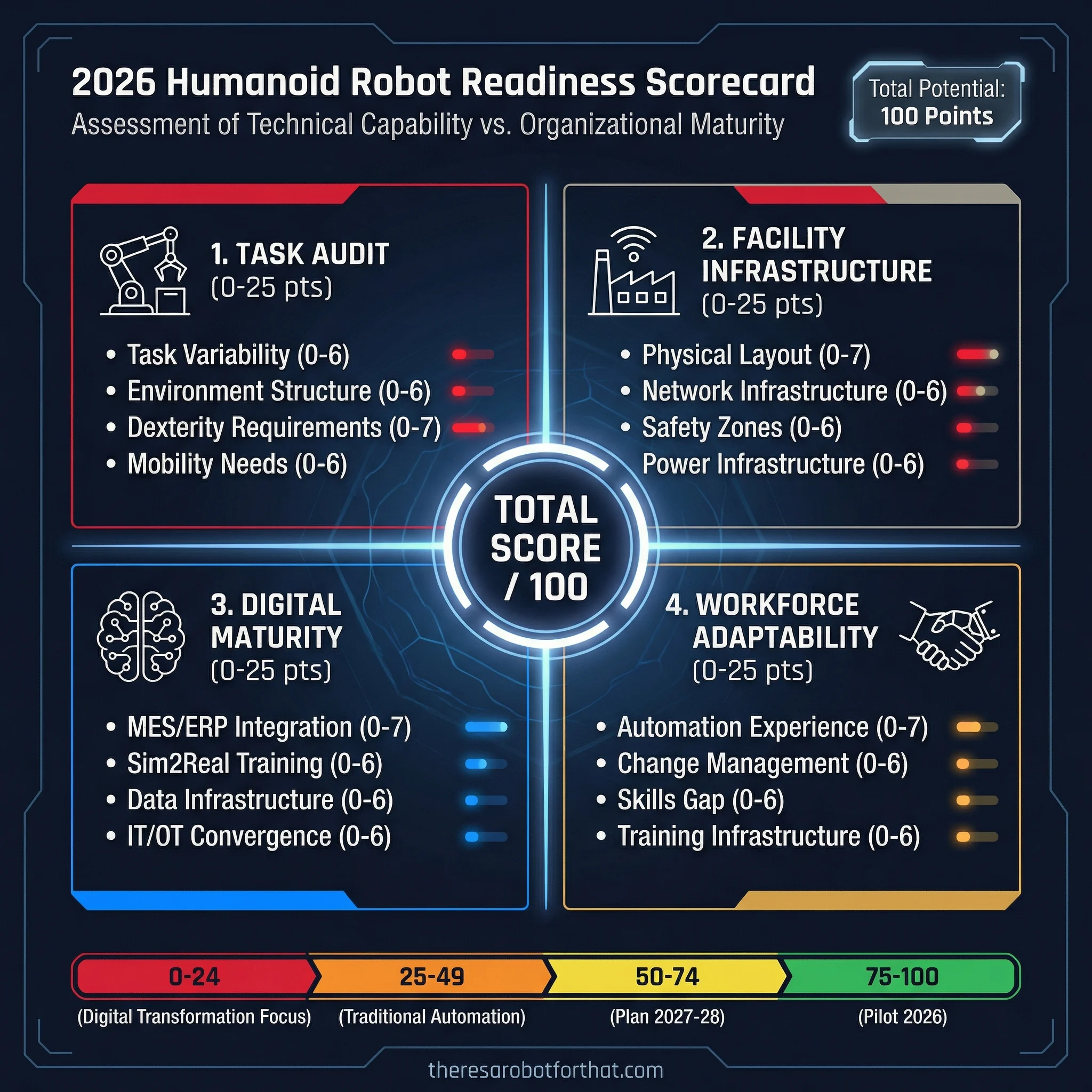
Table of Contents
The Humanoid Decision Matrix: When Does It Make Sense?
Humanoid robots make operational sense in a narrow but growing set of conditions. Unitree’s own internal data tells the story bluntly: only 9% of their android revenue comes from industrial demand, while 74% comes from research and education. (Financial Times, May 2026) The technology is real, but the industrial use case requires specific conditions to be profitable. I weigh the case for and against humanoid robots point by point before the scorecard below.
The decision starts with task characteristics. Fixed-path, high-volume, single-object manipulation is still cheaper with a cobot or traditional industrial arm. Humanoids win when tasks require mobility across a mixed environment, variable object handling, or human-shaped tool use in a space designed for people. Those conditions describe a minority of tasks in most factories today, but a meaningful share in automotive, electronics, and consumer goods manufacturing.
The matrix below maps task and environment characteristics to the likely best fit. Use it as a first-pass filter before scoring your facility in the next section.
| Condition | Humanoid Robot | Cobot / Fixed Arm | Traditional Automation |
|---|---|---|---|
| Task variability (many SKUs, frequent changeovers) | Strong fit | Moderate (reprogramming required) | Poor |
| High-volume, single-object, fixed path | Overkill (expensive) | Good fit | Best fit |
| Mobility required across mixed floor | Strong fit | Poor | Poor |
| Human-designed tool use (standard wrenches, fixtures) | Strong fit | Poor (requires custom tooling) | Poor |
| Precision assembly (<0.1mm tolerance) | Not ready (2026) | Good fit | Best fit |
| Hazardous environment (heat, fumes, crush risk) | Strong fit (where mobility needed) | Moderate | Good fit (fixed-path hazard tasks) |
| Labor shortage with existing human-designed workstations | Strong fit (no retooling) | Requires fixture redesign | Requires full line redesign |
The labor shortage driver is significant. Capgemini found that 74% of executives cite labor shortages as the primary demand driver for humanoid robots in manufacturing. (Capgemini Research Institute, 2026) That’s a structural pull, not a technology push. Where existing workstations were built for human workers and cannot be cost-effectively retooled for fixed automation, a humanoid robot slot in without infrastructure changes. That’s the core economic argument.
The 2026 Humanoid Robot Manufacturing Readiness Scorecard: 4 Critical Dimensions
Stanford University research published in Fortune (May 2026) found that robots scoring nearly 90% in controlled simulations succeed at just 12% of real-world household tasks. Industrial environments, where lighting, floor surfaces, and object positions vary continuously, make that gap even wider. The scorecard below exists to prevent your facility from becoming an expensive lesson in that gap.
Stanford University research (Fortune, May 2026) found that robots scoring nearly 90% success in controlled simulations succeed at just 12% of real household tasks. The gap is even wider in industrial environments where lighting, floor surfaces, and object positions vary continuously. This is the sim-to-real problem that every manufacturing pilot must account for before committing to production use.
Score each item honestly. The goal is an accurate picture of your humanoid robot manufacturing readiness, not the highest possible number. Add up your totals across all four dimensions to get your humanoid robot manufacturing readiness score. The maximum is 100 points. Use this humanoid robot manufacturing readiness assessment quarterly, not just once before a budget decision. Manufacturers who score their humanoid robot manufacturing readiness annually report more accurate deployment timelines and fewer mid-pilot surprises. The four dimensions below reflect the failure modes I’ve tracked across documented deployments, making this humanoid robot manufacturing readiness framework grounded in real production outcomes rather than vendor benchmarks.
Get a free module from the Robot Safety Documentation Toolkit
Enter your email and the 6-page Facility Readiness Checklist lands in your inbox, one complete module from the full toolkit. You also get humanoid robot briefings three times a week. No spam, unsubscribe anytime.
Which Humanoid Platforms Are Actually Ready for Manufacturing in 2026?
The commercial landscape shifted substantially in early 2026. Figure AI began producing Figure 03 at roughly one unit per hour at its BotQ facility, with an estimated purchase price around $20,000 and a RaaS option near $1,000 per month. That cost structure changes the ROI calculation meaningfully compared to 2024 projections. Agility Robotics signed its first commercial manufacturing contract at TMMC in February 2026, following a full year of pilot operation. (Canadian Metalworking, April 2026)
Three real-world deployments provide the clearest signal on what “production ready” actually means right now. Figure 02 logged 1,250 hours at BMW’s Spartanburg, South Carolina plant handling sheet metal parts before Figure 03 entered production. (Fortune, May 2026) Digit ran at TMMC for a year before Agility signed the commercial agreement in February 2026. TMMC is one of Canada’s largest auto manufacturers by volume. Schaeffler has announced that humanoid robots at its Herzogenaurach and Schweinfurt plants must pass 3 months of capability demonstration followed by 3 months of on-site validation before live production use, starting December 2026. (Interesting Engineering, May 2026)
For 5-year TCO models and per-task ROI calculations across each platform, see the complete humanoid robot cost and ROI breakdown.
| Platform | Company | Height / Weight | Payload | Battery | Est. Cost | 2026 Status |
|---|---|---|---|---|---|---|
| Figure 03 (F.03) | Figure AI | 1.73 m / 61 kg | 20 kg | ~5 hr | ~$20K purchase / ~$1K/mo RaaS | Production (1/hr at BotQ) |
| Digit | Agility Robotics | 1.75 m / 64 kg | 16 kg | ~4 hr | RaaS only (pricing undisclosed) | Commercial (7 units at TMMC) |
| Atlas | Boston Dynamics | 1.9 m / ~90 kg | 50 kg | 4 hr (self-swap) | ~$150K-$320K | Pre-production (~4 units/mo) |
| Apollo | Apptronik | TBD | TBD | TBD | TBD | Pre-commercial ($935M raised) |
| Walker S2 | UBTech | TBD | TBD | TBD | $5K/mo RaaS / $180K-$350K purchase | Pilot |
| KUAVO 5 | Leju Robotics | TBD | 20 kg | 8+ hr | TBD | Commercial |
Sources: Figure AI (figure.ai, April 2026), Agility Robotics (Canadian Metalworking, April 2026), Boston Dynamics (Korea Herald, May 2026), Apptronik/Forbes (April 2026), Leju Robotics entity data.
The RaaS model deserves particular attention for manufacturing finance teams. A $1,000 per month RaaS contract for Figure 03 compares directly to loaded labor costs in most developed markets. The critical difference is that you are not carrying the depreciation or technology obsolescence risk. As models iterate, a RaaS arrangement lets you upgrade without stranded capital.
Battery Life: The Constraint Nobody Plans For
No commercially available humanoid platform today covers a full 8-hour shift on a single battery charge. The best performer in the current market is Leju Robotics’ KUAVO 5 at 8-plus hours. Every other platform falls between 3 and 5 hours. That gap forces operational planning decisions that most deployment roadmaps I’ve reviewed don’t account for until the pilot is already running.
The math is straightforward. A platform with a 4-hour runtime on a standard 3-shift operation needs to recharge at least twice per shift cycle, or you need to run a hot-swap battery protocol. Boston Dynamics designed Atlas with a self-swappable battery, which is the most operationally honest engineering decision in the current platform field. The others require planned downtime or fleet redundancy to maintain continuous coverage.
The chart below visualizes active runtime across the platforms with available data. The dashed line at 8 hours marks a typical single shift target. No bipedal platform in current commercial production reaches it.
How to Plan Around the Battery Constraint
There are three practical strategies for covering a full 8-hour shift with platforms that fall short of that runtime. Each has a different cost and operational profile.
Fleet redundancy: Deploy N+1 units, rotating one out for charging while others work. At a $1,000/month RaaS rate, a second Figure 03 unit adds $12,000 per year to cover charging gaps. For a task that replaces a $70,000-per-year labor role, the math still works clearly in favor of the robot fleet.
Shift-aligned charging: Schedule robot downtime during natural shift breaks, handovers, or planned maintenance windows. This works if those breaks sum to at least 3-4 hours per 24-hour cycle. Many three-shift operations have exactly this window built into their scheduling already.
Hot-swap battery protocol: Only Atlas supports this natively in the current field. If continuous uptime is non-negotiable for your use case and Boston Dynamics’ platform meets your other requirements, the self-swap battery design is worth factoring into the platform selection decision.
For a deeper look at the technical blockers that derail early pilots, including network latency, MES integration failures, and Sim2Real gaps, see the humanoid robot pilot challenges guide.
What Does the US Regulatory and Market Environment Look Like for 2026?
The US has a functioning safety standard for human-robot collaboration in manufacturing: ANSI/A3 R15.06-2025. It covers power and force limiting, speed and separation monitoring, and the risk assessment process for collaborative robot deployments. Humanoid robots operating in shared workspaces fall under this standard. Compliance is not optional for any facility seeking to maintain OSHA standing, and it’s a prerequisite for most enterprise insurance policies covering robotic deployments.
The market context is large and accelerating. Yole Group projects the humanoid robot market will exceed $6 billion by 2030 and potentially reach $51 billion by 2035, growing at a 56% CAGR. (Yole Group, May 2026) Roland Berger puts the broader robotics revenue figure at $750 billion by 2035. (Roland Berger, April 2026) Japan has committed $6.3 billion to physical AI investment, signaling that national industrial policy is now a factor in platform development timelines. (Silicon Canals, April 2026)
For US manufacturers, the regulatory picture is cleaner than the market narrative suggests. R15.06-2025 gives compliance teams a clear framework. The more practical challenge is cybersecurity: humanoid robots are networked devices on the production floor, and the IT/OT convergence dimension of the readiness scorecard above reflects exactly that exposure. Facilities without mature IT/OT segmentation face a security audit before any robot vendor will agree to a commercial contract at scale.
The US-China dimension is also real. Several of the most capable and affordable platforms come from Chinese manufacturers. Facilities with government contracts, export-controlled technology, or defense supply chain roles need to factor in the sourcing risk before selecting a platform. This is a procurement and legal question, not a technical one, but it affects the platform shortlist early in the decision process. Browse all currently available models in our humanoid robots for sale buyers guide.
The 2026 humanoid robot safety standards guide covers ANSI/A3 R15.06-2025 implementation checklists and fall zone calculations in detail.
Next Steps Based on Your Humanoid Robot Manufacturing Readiness Score
Your humanoid robot manufacturing readiness score from the four-dimension framework maps directly to a decision path and a realistic budget range. Capgemini’s data showing average timelines to scale at 7 years makes a strong case for starting the groundwork now, regardless of your current score. (Capgemini Research Institute, 2026) The facilities that will deploy at scale in 2028 and 2029 are the ones building digital infrastructure and workforce capability today.
Score 75-100: Fund a 2026 Pilot
Your humanoid robot manufacturing readiness score shows you have the task profile, infrastructure, and workforce capability to run a structured pilot this year. The recommended budget range is $100,000 to $300,000 for a 6-12 month pilot covering one to three units, integration engineering, safety validation, and operator training.
Spend the first 60 days on task selection, not robot selection. Identify the 3-5 tasks that score highest on variability, mobility, and labor cost impact. Run those through the decision matrix from Section 1. Then issue RFPs to the platforms that fit your task profile. Insist on a minimum 3-month capability demonstration before any live production commitment, following the Schaeffler model. (Interesting Engineering, May 2026)
Define success metrics before the pilot starts, not during it. Active uptime percentage, task success rate, maintenance hours per week, and worker sentiment scores are the four I’d recommend tracking from day one. Build a go/no-go decision gate at the 90-day mark.
The 5-phase implementation guide covers each of these milestone gates with templates and timing benchmarks drawn from documented deployments.
Score 50-74: Plan for 2027-2028 Deployment
A humanoid robot manufacturing readiness score in this range indicates a solid foundation with specific gaps that would undermine a 2026 pilot. The right move is a 12-18 month infrastructure and capability build, with a target launch window of Q1 2027 or Q1 2028 depending on the severity of the gaps. Budget $50,000 to $150,000 for this preparation phase.
Look at which dimension of your humanoid robot manufacturing readiness score scored lowest. If it was Digital Infrastructure, prioritize MES API access and a partial digital twin of the pilot zone. If it was Workforce Adaptability, build operator competency early with a structured robot safety training program, whether through a community college partnership or a cobot vendor’s curriculum, before the humanoid pilot begins. If it was Facility Infrastructure, start with the network and power work, as those have the longest procurement and installation timelines.
Use this window to engage vendors in structured conversations. Most commercial humanoid vendors will share their deployment requirements documentation freely in exchange for a signed NDA. That documentation tells you exactly what they’ll need from your facility, and I cross-reference it against my own robot safety documentation and compliance checklist to make sure nothing falls through the gaps. Reverse-engineer your preparation checklist from it.
Score 25-49: Traditional Automation Is the Better Investment Today
A humanoid robot manufacturing readiness score in this range typically indicates that fixed automation, cobots, or AMRs would deliver better returns on your current task profile and infrastructure than a humanoid pilot. That’s not a failure state. It means the economic analysis is pointing you toward a faster, cheaper win with existing technology.
The productive path here is a cobot or AMR deployment in 2026, using that project to build the automation experience, data infrastructure, and workforce skills that lift your humanoid robot manufacturing readiness score by 2028. Cobot deployments in the $30,000-$80,000 range routinely build exactly the operator readiness and MES integration capability that closes the gaps in Dimensions C and D.
Score 0-24: Digital Transformation Must Come First
A humanoid robot manufacturing readiness score below 25 indicates fundamental infrastructure gaps that no robot vendor can work around. The facility either lacks the network connectivity, data architecture, or automation experience to support a humanoid deployment at any budget level. Attempting a pilot with a low humanoid robot manufacturing readiness score wastes capital and can set back internal enthusiasm for automation by years.
The 2026 priority is a digital transformation roadmap: industrial Wi-Fi or 5G on the floor, a basic MES if one doesn’t exist, IoT sensor coverage on key machines, and at least one successful automation project of any kind to build organizational learning. A realistic timeline to reach a humanoid robot manufacturing readiness score of 50 from this baseline is 24-36 months with sustained investment.
The Human Factor: Why Workforce Readiness Determines Pilot Outcomes
Every failed humanoid pilot I’ve tracked had a workforce problem at its root. Not a technology problem. The robot did what it was designed to do. But the workers around it, the supervisors responsible for it, and sometimes the union representatives who hadn’t been briefed on it created friction that the technology could not overcome. Workforce adaptability (Dimension D of the humanoid robot manufacturing readiness scorecard) has a 25-point weighting for exactly this reason.
The communication strategy has to precede the robot by at least 90 days. Workers need to understand what the robot will do, what it won’t do, and critically, what the organization’s commitment is to their continued employment and development. Vague reassurances create more anxiety than concrete plans, even if the concrete plan involves role changes.
The robot supervisor role is the most important new job description to create before a pilot. This person monitors robot performance, handles exception cases, coordinates with IT on connectivity issues, and serves as the primary feedback channel between the robot’s actual behavior and the vendor’s engineering team. In my observation, the best robot supervisors are experienced floor workers who show curiosity about technology. They already know the task domain. Adding the robot layer is far easier than training a technician to understand the production context.
Union engagement is a separate conversation from worker communication, but it has to happen early. Unions want to see: what happens to displaced workers, what the pay grade for robot supervision will be, and what the grievance process is if the robot causes a safety incident. Having answers to those three questions prepared before the union’s first briefing removes the most common friction points before they become delays.
Common Pitfalls That Derail Humanoid Pilots
I’ve catalogued the failure modes that appear repeatedly across public pilot reports and vendor disclosures. These are not edge cases. They’re the standard ways that otherwise well-resourced organizations waste their first humanoid deployment budget. Every one of them directly reduces your humanoid robot manufacturing readiness score in at least one of the four dimensions above.
For a full analysis of what goes wrong and the financial cost of each error, see the companion piece: 7 humanoid robot deployment mistakes manufacturing leaders must avoid.
Pitfall 1: Selecting the Robot Before Selecting the Task
The most common mistake is choosing a platform based on a demo, a trade show, or a competitor’s announcement, then trying to find tasks that fit it. The correct order is the reverse. Define the 3-5 tasks that have the highest impact and best fit for humanoid capability. Then evaluate which platforms can perform those specific tasks at acceptable accuracy. Platform selection is the output of task analysis, not the input.
Pitfall 2: Underestimating Integration Engineering Time
Vendor demos show the robot performing the task. They don’t show the 3-6 months of MES integration, safety system configuration, digital twin development, and network hardening that precede it. Schaeffler’s publicly disclosed protocol of 3 months capability demonstration plus 3 months on-site validation before live production reflects the actual engineering timeline. Build at least 6 months of pre-production engineering into any pilot budget and schedule.
Pitfall 3: Setting Success Metrics After the Pilot Starts
Pilots without pre-defined success metrics become endless. Stakeholders shift the definition of success as results come in. The pilot budget gets extended. Conclusions are never reached. Define four to six specific, measurable metrics before signing any vendor contract. Include a hard decision date at which the go/no-go determination will be made regardless of progress.
Pitfall 4: Confusing Demo Performance with Production Performance
The Stanford sim-to-real finding is directly applicable here. A 90% success rate in a controlled environment becomes 12% in an uncontrolled one. In a factory, lighting changes across a 12-hour shift. Floors accumulate debris. Object positions shift. Require vendors to demonstrate task performance under your actual production conditions, not in a controlled demo environment. Build that condition into the contract.
Pitfall 5: No Maintenance Plan Before Day One
Who fixes the robot when it goes down at 2:00 AM on a Saturday? This question needs a documented answer before the robot arrives. Vendor response time SLAs, spare parts inventory, on-site maintenance training for internal technicians, and escalation protocols all need to be written into the contract and the internal operations manual. The pilot that stalls because no one knows who to call for a sensor failure is a preventable failure.
Frequently Asked Questions
What does a humanoid robot manufacturing pilot actually cost in 2026?
Facilities with a humanoid robot manufacturing readiness score of 75 or above typically spend $100,000 to $300,000 on a structured 6-12 month pilot covering one to three units. That includes robot lease or RaaS fees (Figure 03 at approximately $1,000/month per unit, for example), integration engineering, safety system upgrades, operator training, and a dedicated robot supervisor role. Hardware purchase cost can range from $20,000 for Figure 03 to $150,000-$320,000 for Boston Dynamics Atlas. (Figure AI, April 2026; Korea Herald, May 2026) RaaS models reduce upfront capital risk but extend the cost over time. For a detailed ROI breakdown, see the humanoid robot cost and ROI guide.
Which humanoid robot is best for automotive manufacturing in 2026?
Digit and Figure 03 have the most credible automotive track records currently. Digit logged a year of pilot operation at TMMC (Toyota’s Woodstock, Ontario facility) before a commercial agreement was signed in February 2026. Figure 02 accumulated 1,250 hours at BMW Spartanburg handling sheet metal. (Fortune, May 2026; Canadian Metalworking, April 2026) Atlas from Boston Dynamics has the highest payload at 50 kg and self-swappable battery, making it better suited for heavier material handling. The right platform depends on your specific task profile, not automotive sector membership in general.
How long does it take to deploy a humanoid robot in a manufacturing plant?
The Schaeffler deployment protocol for its German plants gives the clearest public benchmark: 3 months of off-site capability demonstration followed by 3 months of on-site validation before live production use, starting December 2026. (Interesting Engineering, May 2026) That 6-month pre-production phase is consistent with what I’ve tracked across other deployments. Add 2-3 months for procurement, contracts, and facility preparation before that clock starts. A realistic end-to-end timeline from decision to live production is 9-15 months for a facility scoring 75 or above on the humanoid robot manufacturing readiness scorecard.
Is the sim-to-real gap a solved problem for industrial robots?
Not yet. Stanford University research published in Fortune (May 2026) found that robots scoring nearly 90% success in controlled simulations succeed at just 12% of real household tasks. Industrial environments, with variable lighting, floor debris, and shifting object positions, present similar challenges. The gap is narrowing as vendors invest in synthetic data generation and on-robot learning, but it remains the central technical risk in every humanoid pilot in 2026. Requiring vendors to demonstrate task performance under your actual production conditions (not in their demo environment) is the most direct mitigation available today.
Do humanoid robots replace workers or augment them?
The commercial evidence in 2026 points primarily to augmentation, not replacement, as the near-term reality. Agility Robotics’ deployment at TMMC was driven by chronic labor shortages in specific roles, not by a cost reduction mandate against existing workers. Unitree’s own data showing only 9% of android revenue from industrial demand confirms that manufacturing adoption is still early and highly selective. (Financial Times, May 2026) The more immediate workforce effect is the creation of new robot supervisor and maintenance roles. Facilities with high humanoid robot manufacturing readiness scores (particularly in Dimension D) handle this transition with fewer disruptions than those that treat workforce preparation as an afterthought.
Further Reading
- Humanoid Robots in Manufacturing: Real Deployments, Proven Results, and 2026 Data: case studies from BMW, Toyota Canada, and Schaeffler
Sources
- Capgemini Research Institute. (2026). Physical AI and Humanoid Robots: Executive Survey 2026. capgemini.com. Referenced for 67% executive transformation belief, 74% labor shortage driver, and 7-year average scale timeline.
- Stanford University / Fortune. (May 2026). Sim-to-real gap research: robots scoring 90% in simulations succeed at 12% of real-world tasks. fortune.com.
- Yole Group. (May 2026). Humanoid robot market projections: 56% CAGR, $6 billion by 2030, $51 billion by 2035. eenewseurope.com.
- Roland Berger. (April 2026). Global robotics revenue projection: $750 billion by 2035. assemblymag.com.
- Silicon Canals. (April 2026). Japan commits $6.3 billion to physical AI investment. siliconcanals.com.
- Figure AI. (April-May 2026). Figure 03 specifications, BotQ production rate, and autonomous sorting endurance. figure.ai.
- Canadian Metalworking. (April 2026). Agility Robotics commercial agreement at Toyota Motor Manufacturing Canada (TMMC). canadianmetalworking.com.
- Fortune. (May 2026). Figure 02 at BMW Spartanburg: 1,250 hours of sheet metal handling. fortune.com.
- Interesting Engineering. (May 2026). Schaeffler humanoid deployment protocol at Herzogenaurach and Schweinfurt. interestingengineering.com.
- Financial Times. (May 2026). Unitree Robotics revenue: 9% industrial, 74% research and education. ft.com.
- Korea Herald. (May 2026). Boston Dynamics Atlas specs and Hyundai deployment plans. koreaherald.com.
- Forbes. (April 2026). Apptronik Apollo: $935 million Series A funding. forbes.com.
- Association for Advancing Automation (A3). ANSI/A3 R15.06-2025: American National Standard for Industrial Robots and Robot Systems. a3automate.org.
- International Federation of Robotics. (2026). Top 5 Global Robotics Trends 2026. ifr.org.
- Leju Robotics. (2026). KUAVO 5: 8+ hour battery life, 20 kg payload specifications. leju.com.

Ulrich Baldauf is the founder of There’s A Robot For That, covering humanoid robotics for manufacturing and industrial operations. He has tracked the humanoid robot sector since 2024, with a focus on safety standards (ISO 10218, EU Machinery Regulation 2023/1230) and what deployments mean for operations and EHS teams. Connect on LinkedIn: linkedin.com/in/ubaldauf