

How do humanoid robots work? By combining five tightly integrated systems: perception (cameras and sensors to see the world), locomotion (motors and AI to walk and balance), manipulation (hands and arms to grasp objects), an AI brain (deep learning to make decisions), and a power system (battery and actuators to move). Together, these systems let a robot like Tesla Optimus or Figure 03 walk across a warehouse floor, pick up a package, and adapt to unexpected obstacles without human guidance. By the end of 2025, an estimated 16,000 humanoid robots were operating in commercial settings worldwide, a figure expected to surpass 50,000 in 2026 alone (Counterpoint Research, Jan 2026).
Key Takeaways
• What is a humanoid robot? A robot built with a human-like body plan, a head, a torso and two arms, that walks on two legs or rolls on a wheeled base so it can work in spaces and with tools designed for people.
• Modern humanoid robots use 30-56 degrees of freedom (Boston Dynamics Atlas has 56), onboard LiDAR, stereo cameras, and force sensors to navigate and interact with the physical world (Boston Dynamics, 2025).
• Foundation models trained on simulation and human demonstration data now let robots generalize to new tasks, with Sim2Real methods training balance policies on 40-hour motion datasets in 1-2 hours (Stanford/arXiv, 2024).
• Battery runtime for leading humanoid robots in 2025-2026 ranges from 90 minutes to 8 hours per charge depending on task intensity, with swappable packs enabling continuous shift coverage.
• The global humanoid robot market is forecast to reach $38 billion by 2035; 16,000 units were already installed worldwide by end of 2025 (Goldman Sachs, 2024; Counterpoint Research, Jan 2026).
The most consistent gap in coverage of this field is that the headline capabilities get explained and the engineering trade-offs underneath do not. This guide on how humanoid robots work breaks down every layer, from the ground up, the way a systems engineer would explain it to a plant manager. It starts with the definition, because what counts as a humanoid robot decides which of these systems a machine needs at all.
For a broader look at the competitive landscape, check my complete guide to humanoid robot companies in 2026. If you want the definition and the types first, start with what a humanoid robot is, then read on for the mechanics underneath.
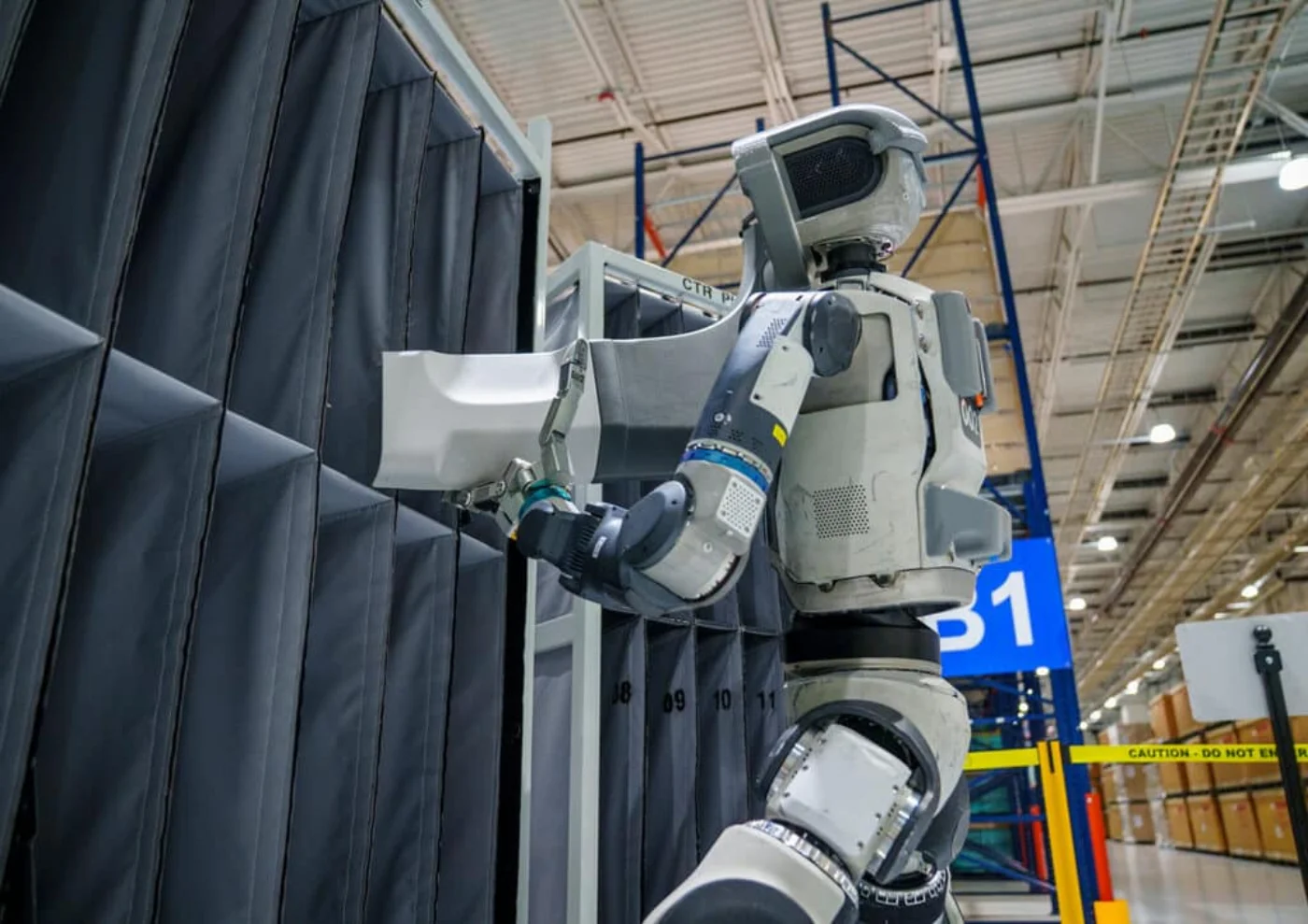
Table of Contents
What Is a Humanoid Robot?
A humanoid robot is a robot built with a human-like body plan, typically a head, a torso and two arms, that moves on two legs or a wheeled base. It is designed to operate in spaces built for people and to use tools made for human hands, so factories, warehouses and homes do not have to be rebuilt around it. In industry, humanoid robots run structured pilots in manufacturing and logistics; at home, the first domestic models are just reaching early adopters.
The human shape is not styling, it is a compatibility decision. Almost every workplace, doorway, staircase, shelf and tool on earth was designed around the human body. A machine with that same geometry can, in principle, take over tasks in those environments without conveyor rebuilds or new fixtures. That single argument carries the entire commercial case for humanoids, and it is why most people asking what is a humanoid robot are really asking whether one machine can slot into a workplace built for people.
One boundary worth drawing early: a humanoid robot is not the same thing as an android. An android is a humanoid robot deliberately designed to look and act convincingly human, with synthetic skin, facial expressions and lifelike movement. The industrial and domestic machines in this guide sit on the other side of that line. They keep the human body plan for practical reasons and stay visibly robotic. The rest of this guide explains how the machines achieve any of this, system by system.
What Types of Humanoid Robots Exist?
Four practical categories cover the market in 2026: bipedal industrial robots, wheeled-base industrial robots, domestic humanoids, and research or education platforms. The locomotion split matters more than the marketing suggests, because legs and wheels solve different problems.
| Type | Body plan | Where you see it in 2026 | Examples |
|---|---|---|---|
| Bipedal humanoid | Full human body plan, walks on two legs | Factory and warehouse pilots | Figure 03, Agility Digit |
| Wheeled-base humanoid | Human-like torso and arms on a wheeled base | Smooth-floor industrial and service work | Humanoid HMND 01 Alpha (wheeled variant) |
| Domestic humanoid | Human scale, designed for home environments | Early home deployments | 1X NEO |
| Research and education platform | Often smaller, built for development work | Universities, labs, care-setting studies | Unitree G1, NAO |
One precision rule I apply everywhere on this site: bipedal and wheeled versions are different models, even when they share a product name. Several manufacturers now ship a walking flagship alongside a wheeled sibling, and the two differ in runtime, payload, speed and price. A spec published for one variant tells you nothing reliable about the other, so always check which form factor a claim refers to. The full roster of who builds what sits in my guide to humanoid robot companies in 2026.
How Do Humanoid Robots See and Sense the World?
Humanoid robots perceive their environment through a layered stack of sensors: stereo RGB cameras for depth perception, LiDAR for precise 3D mapping, IMUs (inertial measurement units) for balance, and arrays of force/torque sensors in the hands and feet. Figure 03, for example, carries six stereo cameras with a 60% wider field of view per camera than its predecessor, and fingertip tactile sensors that detect forces as small as 3 grams of pressure, enough to sense a single paperclip (Figure AI, Oct 2025). Agility Digit uses four Intel RealSense depth cameras, LiDAR, MEMS IMU, and dedicated force sensors in each arm (The Robot Report, ProMat 2025).
The perception stack is what separates today’s humanoid robots from the remote-controlled machines of a decade ago. Instead of being told exactly where every object is, modern robots build a real-time 3D map of their surroundings, identify objects, and predict how those objects will move.
Sensor Types on Leading Humanoid Robots
Cameras: Stereo pairs give depth from parallax, while fisheye cameras extend the field of view. Some robots, including Tesla Optimus Gen 2, use a pure-camera approach similar to Tesla’s autonomous vehicles, processing 2D images through neural networks rather than relying on LiDAR.
LiDAR: Time-of-flight sensors shoot laser pulses and measure return times to build point clouds at millimeter accuracy. Boston Dynamics Spot and early Atlas platforms used rotating LiDAR heads; newer designs favor solid-state units embedded in the chest or head.
Force and Torque Sensors: Embedded in wrists and ankles, these tell the robot how hard it’s pressing against a surface. Without them, a robot picking up an egg would either crush it or drop it. Agility Robotics Digit uses 6-axis force/torque sensors in each foot to detect ground compliance and adjust gait in real time.
IMU: A nine-axis IMU (accelerometer + gyroscope + magnetometer) runs continuously, giving the bipedal system its sense of “which way is down.” The IMU data feeds directly into the balance controller at update rates above 1,000 Hz.
Teardown documentation from Figure 02’s development cycle, one detail stood out: the perception stack’s ability to detect subtle floor texture changes through vibration signatures in the foot force sensors. This proprioceptive feedback, below the resolution of the cameras, is what lets the autonomous platform adjust gait 40-60 milliseconds before a camera-based system would even register the surface change.
Humanoid robots like Figure 02 and Tesla Optimus process sensor data from cameras, LiDAR, and inertial systems simultaneously using dedicated neural processing units. This edge computing approach keeps latency below 10 milliseconds, which is critical for dynamic balance during walking and stair climbing (Figure AI, 2025).
How Do Humanoid Robots Walk and Balance?
Walking is the hardest engineering problem in humanoid robotics. A robot balances on a single foot for roughly 60% of each stride cycle, meaning the control system must constantly predict and correct its center of mass. Leading robots achieve this through a combination of Model Predictive Control (MPC), reinforcement learning, and high-torque actuators capable of responding in milliseconds.
Balance Control: The Physics Problem at the Core
Bipedal walking is inherently unstable. Unlike a four-legged robot or a wheeled platform, a humanoid robot is always falling forward, correcting, and falling forward again, which explains why a powered-off biped falls, and what that means for maintenance. Engineers solve this with Zero Moment Point (ZMP) control or, in newer systems, whole-body Model Predictive Control.
ZMP Control (legacy): Predicts where the resultant ground reaction force acts and keeps it inside the foot’s support polygon. Works reliably on flat ground but struggles with uneven terrain.
MPC + RL (modern): Solves an optimization problem 50-200 times per second, predicting the robot’s trajectory 0.5-2 seconds into the future and selecting motor commands that keep it balanced. Reinforcement learning policies, trained in simulation over billions of steps, add adaptive reflexes that ZMP cannot replicate.
Actuators: What Makes the Joints Move
Every joint in a humanoid robot is driven by an actuator, typically a brushless electric motor paired with a gearbox. The choice of actuator defines the robot’s speed, strength, and energy efficiency.
- Series elastic actuators (SEA): A spring in series with the motor gives compliant, force-controlled joints that are safer for human contact. Used by Boston Dynamics Atlas.
- Quasi-direct drive (QDD): High-torque motors with low-ratio gears allow fast, backdrivable joints. MIT Cheetah and many newer humanoids use this approach.
- Hydraulic actuators: Atlas v1-v4 used hydraulic actuators for extreme torque density. Boston Dynamics abandoned hydraulics in the all-electric Atlas released in 2024.
Most 2025-2026 commercial humanoids use 29-56 degrees of freedom. Boston Dynamics Atlas leads with 56 DOF and a 50 kg instant payload capacity (Boston Dynamics, 2025). Figure 03 has 44 DOF with 16 per hand, Tesla Optimus Gen 3 approximately 40 DOF with 22 in the hands, and Unitree G1 covers 29 DOF optimized for efficient bipedal locomotion, platforms I profile in depth in my complete guide to humanoid robot companies.
Keep up with what these robots can really do
Three briefings a week on real deployments, published prices, and the safety rules that apply. Sourced figures, no hype. Free, unsubscribe anytime.
How Do Humanoid Robots Manipulate Objects?
Manipulation is the skill that determines how useful a humanoid robot actually is in the real world. A robot that can walk into a factory but can’t reliably pick up components has limited value. Dexterous manipulation requires precise motor control, rich tactile feedback, and AI that understands object geometry.
Modern humanoid hands carry force-sensitive resistors and capacitive tactile arrays across every finger segment. This lets robots detect slip before an object falls, adjust grip force dynamically, and handle fragile items like circuit boards and produce without damage. Figure AI demonstrated reliable bottle and box handling in BMW’s Spartanburg plant in early 2025 (Figure AI, BMW Group, 2025).
Grasping Strategies: Power vs. Precision
Robots need two fundamental grasping modes:
Power grasp: Wrapping all fingers around a large object for maximum holding force. Used for moving boxes, turning valves, and pushing carts.
Precision grasp (pinch): Using fingertips to handle small or delicate objects. Requires sub-millimeter positioning accuracy and fine force control.
The challenge is that the robot must recognize which grasp strategy is appropriate, then execute it. This is solved by a combination of 3D object detection (often using FoundationPose or similar neural networks) and grasp planning algorithms that generate candidate grasp poses and score them by stability.
The “Last Centimeter” Problem
Industrial robots have been positioning arms to within 0.05 mm repeatability for decades. Humanoid robot arms typically achieve 1-3 mm repeatability in 2025-2026, good enough for pick-and-place and assembly of medium-tolerance parts but not yet at the precision of fixed-arm cobots for fine electronics work.
Advances in visual servoing, where the robot continuously adjusts based on real-time camera feedback during the final approach, are closing this gap. Figure AI reports achieving reliable assembly task completion rates above 95% in controlled BMW production environments (Figure AI, 2025).
For a detailed breakdown of how humanoid robots compare to traditional cobots on the factory floor, read my humanoid robots vs cobots manufacturing comparison.
How Does the AI Brain of a Humanoid Robot Work?
The AI layer is what makes a 2026 humanoid robot categorically different from the sensor-driven automatons of the 2010s. Modern robots run foundation models: large neural networks pre-trained on massive datasets that can generalize to tasks and environments not seen during training.
Foundation Models and Robot Learning
Figure AI’s Helix model and Google DeepMind’s RT-2 are examples of vision-language-action (VLA) models that take camera images and natural language instructions as inputs and output low-level motor commands. This means an operator can say “pick up the red wrench and place it in the toolbox” and the robot understands both the semantics (what a wrench is) and the physics (how to grasp it).
Training these models requires:
• Simulation data: Thousands of parallel robot instances run simultaneously in physics simulators like IsaacSim or MuJoCo, accumulating the equivalent of years of experience in hours. Sim2Real techniques, using a 40-hour human motion dataset, can train a balanced walking policy in just 1-2 hours of real compute time (Stanford / arXiv, Jun 2024).
• Human demonstration data: Teleoperated recordings of humans completing tasks, captured through VR controllers or exoskeletons. The robot learns the causal structure of the task, not just the hand positions.
• Real-world fine-tuning: A small number of on-robot demonstrations in the target environment adapts the general policy to local conditions, such as specific lighting, floor textures, or product variants.
Edge vs. Cloud AI Processing
A critical design decision is where computation runs. Cloud processing offers unlimited compute power but introduces latency. For dynamic balance and reactive grasping, latency above 50 ms is unacceptable, so balance control always runs on embedded hardware.
Higher-level reasoning (understanding a verbal instruction, planning a multi-step task) can tolerate more latency and may run on cloud inference clusters. Most production humanoids use a hybrid architecture: fast reflex loops onboard at 500 Hz-1 kHz, and slower cognitive layers at 5-30 Hz that draw on cloud compute.
Foundation models have fundamentally changed the robot learning paradigm. Rather than programming a robot for each specific task, engineers now train a single generalist policy and fine-tune it with a few hours of demonstration data per new task. Google DeepMind’s RT-2 demonstrated this with a 50% improvement in novel task generalization compared to task-specific models (Google DeepMind, 2023).
How Are Humanoid Robots Powered?
Power is the constraint that shapes everything else. Every actuator, sensor, and compute board draws current, and the robot must carry its own energy source.
Battery Technology: Lithium-Ion and the Race for Energy Density
All commercial humanoid robots in 2025-2026 use lithium-ion or lithium-polymer battery packs, the same chemistry found in electric vehicles. Typical pack capacities range from 1 kWh to 2.5 kWh, delivering 2-5 hours of operating time depending on workload intensity.
Walking on flat ground is relatively efficient. Climbing stairs, carrying heavy payloads, or running high-power compute simultaneously drives power consumption up sharply. A humanoid robot performing intensive manipulation tasks may consume 300-500 W continuously, draining a 1.5 kWh pack in about 3 hours.
The swappable pack solution: For continuous industrial operations, robot fleets use battery-swapping stations. One robot works while another charges. Agility Robotics’ SAFE (Software, Apps, and Fleet Equipment) system and Figure’s warehouse deployments at BMW both use this rotation model.
Actuator Efficiency: Where the Energy Goes
Roughly 60-75% of a humanoid robot’s total power budget goes to the actuators, particularly during dynamic activities like walking. Improving actuator efficiency is therefore the single biggest lever for extending battery life.
Brushless DC motors paired with custom controllers now achieve 90-95% conversion efficiency. The remaining losses appear as heat in the motor windings and gearbox. Thermal management (heat pipes, active cooling) becomes critical in sustained high-activity scenarios.
In conversations with logistics operators piloting humanoid platforms, the battery constraint consistently ranks as the top operational concern, above cost and above dexterity limitations. A 2-hour runtime means the robot completes roughly 60-70% of a standard 3-hour picking shift before needing a swap. Teams that did not budget for a battery rotation infrastructure in their pilots found it was the difference between a successful deployment and a stalled one.
For full pricing and ROI analysis including total cost of ownership including charging infrastructure, see my humanoid robot cost and ROI breakdown.
How Do Humanoid Robots Work as Integrated Systems?
Understanding each subsystem is one thing. Seeing how they integrate in real operation is another. Here’s what happens in the 200 milliseconds it takes a humanoid robot to detect, approach, and pick up a box:
- Perception (0-20 ms): Cameras and LiDAR update the 3D scene map. The vision model identifies the box, estimates its pose (position + orientation), and flags candidate grasp points.
- Planning (20-80 ms): The motion planner computes a collision-free arm trajectory to the grasp point. Simultaneously, the gait controller adjusts the robot’s footing to position the body optimally.
- Execution (80-180 ms): The arm moves along the planned trajectory. Visual servoing corrects the final 3-5 cm using live camera feedback. Fingers close around the box.
- Sensing + Correction (180-200 ms): Force sensors confirm grasp stability. If slip is detected, the grip force increases automatically. The IMU and leg controllers keep the robot balanced throughout.
This cycle repeats continuously. Over a full shift, the robot executes thousands of such sense-plan-act cycles, adapting to variability in box position, weight, and surface texture without human intervention.
What makes this remarkable is not any single subsystem but the tight integration of all five. A robot with great locomotion but poor manipulation is useless for warehouse work. A robot with expert hands but inadequate sensing can’t find the box. The 2025 generation of humanoid robots is the first to close the loop reliably enough for real commercial deployment.
What Are the Current Limitations of Humanoid Robots?
Honest assessment matters as much as enthusiasm. Here’s where the technology still falls short in 2026:
Dexterity ceiling: Sub-millimeter precision assembly is still beyond most humanoid hands. Tasks requiring very fine motor control, like electronics soldering or suturing, remain in the cobot and surgical robot domain. For a broader look at the technical and operational hurdles the industry is still working through, see my overview of the biggest challenges facing humanoid robots in 2026.
Battery life: Two to five hours per charge limits continuous shift coverage without infrastructure investment in battery-swapping stations.
Cost: Manufacturer-published prices for commercial humanoid robots in 2026 run from about $13,500 to $100,000 per unit. The enterprise platforms most often shortlisted, such as Figure 03, Boston Dynamics Atlas and Apptronik Apollo, publish no price at all and sell by quote. Return on investment requires careful workload matching. See my readiness framework for 2026 before committing to a pilot.
Generalization gaps: Foundation models handle many tasks well but can fail unexpectedly on out-of-distribution inputs, such as objects with unusual reflectance or highly cluttered scenes. Active human supervision is still required for edge cases.
Safety certification: Industry-specific safety standards for humanoid robots are still being developed. ISO/TS 15066 covers collaborative robots but was not written with fully bipedal humanoids in mind. Review my humanoid robot safety standards guide for 2026.
What Does the Future of Humanoid Robot Technology Look Like?
The trajectory is clear. Robots are getting faster, smarter, cheaper, and more dexterous each year, with major inflection points likely in 2026-2028.
Near-term (2026-2027): Battery energy density improvements from solid-state cells will extend runtime to 8-10 hours. Foundation model fine-tuning will drop to hours instead of weeks. Manipulator dexterity will approach human-level for a broader range of tasks.
Medium-term (2028-2030): Cost will fall below $30,000 per unit for capable platforms as supply chains mature. Humanoid robots will become standard infrastructure in automotive assembly, e-commerce fulfillment, and food processing.
Long-term (2030+): Home deployment becomes economically viable. Robots capable of general household tasks will reach the consumer market, though broad adoption depends on cost parity with human labor in specific markets.
Goldman Sachs projects the addressable market for humanoid robots could reach $38 billion by 2035 (Goldman Sachs, 2024). MarketsandMarkets puts the near-term trajectory at $2.92 billion in 2025 growing to $15.26 billion by 2030, a 39.2% compound annual growth rate (MarketsandMarkets, 2025). With 16,000 units installed globally in 2025 and TrendForce projecting 50,000+ shipments in 2026, the growth curve is accelerating faster than most analysts predicted (Counterpoint Research, Jan 2026; TrendForce, Jan 2026). To see this technology applied in real factory environments today, read my in-depth look at humanoid robots in manufacturing and the current state of industrial deployments.
The Humanoid Robot Technology Stack: A Quick Reference
| System | Technology | Leading Example |
|---|---|---|
| Perception | Stereo cameras, LiDAR, IMU, force sensors | Figure 02 (6-camera suite) |
| Locomotion | MPC + RL, brushless motors, 28-44 DOF | Unitree H1, Tesla Optimus |
| Manipulation | VLA models, tactile sensing, visual servoing | Figure 02 (BMW deployment) |
| AI Brain | Foundation models (VLA), edge + cloud hybrid | Google RT-2, Figure Helix |
| Power | Li-ion/LiPo packs, 1-2.5 kWh, swappable | Agility Digit fleet system |
Frequently Asked Questions
What is a humanoid robot in simple terms?
A humanoid robot is a machine with a human-like body: a head, a torso, two arms, and either two legs or a wheeled base. It is built that way so it can work in places designed for people and use tools designed for human hands, from factory workstations to kitchen counters.
What is the difference between a humanoid robot and an android?
An android is a humanoid robot designed to look convincingly human, with synthetic skin, a face and lifelike expressions. Industrial and domestic humanoids keep the human body plan for practical compatibility but remain visibly robotic. Every robot in my market comparison is a humanoid; none of them is an android.
How do humanoid robots work?
Humanoid robots work by integrating five core systems: perception sensors (cameras, LiDAR, IMUs) to see the environment, locomotion actuators and AI balance controllers to walk, manipulation hardware (dexterous hands) to grasp objects, an AI brain running foundation models for decision-making, and a battery power system. These five layers run simultaneously, sharing data through a central compute stack that processes sensor input and issues motor commands in under 10 milliseconds.
How do humanoid robots keep their balance while walking?
Humanoid robots balance using a combination of Model Predictive Control and reinforcement learning policies running at 500-1,000 Hz. These read IMU data and joint torque sensors to predict and correct the center of mass position up to 2 seconds in advance, preventing falls on uneven terrain. The system is similar to how autonomous vehicles predict road behavior, but operating at much faster timescales for physical stability.
What sensors do humanoid robots use?
Most 2025-2026 humanoid robots use stereo RGB cameras (2-6 units), solid-state LiDAR, a 9-axis IMU, 6-axis force/torque sensors in wrists and ankles, and capacitive or resistive tactile sensors in the fingers. Some robots also include microphone arrays for speech recognition and ultrasonic proximity sensors for close-range obstacle avoidance. Explore my full guide to humanoid robot models and specs for sensor comparisons by platform.
How long do humanoid robot batteries last?
Commercial humanoid robots in 2026 typically run 2-5 hours per charge under working load. Tesla Optimus and 1X NEO Beta report 4-5 hour runtimes. Agility Digit and Unitree H1 fall closer to 1.5-2 hours in high-activity scenarios. Industrial deployments use battery-swapping stations for continuous operation across full shifts.
How do humanoid robots learn new tasks?
Humanoid robots learn new tasks through a combination of imitation learning (watching human demonstrations captured via teleoperation), reinforcement learning in simulation (billions of simulated practice runs), and fine-tuning with a small number of real-world demonstrations. Foundation models like Google’s RT-2 allow robots to generalize from this training to unfamiliar variations of a task.
What is the difference between humanoid robots and cobots?
Cobots (collaborative robots) are fixed-arm industrial robots designed to work safely alongside humans. They excel at repetitive, high-precision tasks at a fixed workstation. Humanoid robots are mobile, bipedal, and general-purpose, able to move through facilities and handle diverse tasks. Read my detailed humanoids vs cobots comparison for a side-by-side breakdown of cost, precision, and ROI.
Sources
- Counterpoint Research. https://roboticsandautomationnews.com/2026/01/30/global-humanoid-robot-installations-reach-16000-units-as-commercial-deployments-accelerate/98422/
- Boston Dynamics. https://bostondynamics.com/atlas/
- Stanford/arXiv. https://arxiv.org/pdf/2406.10454
- Goldman Sachs. https://www.goldmansachs.com/insights/articles/the-global-market-for-robots-could-reach-38-billion-by-2035
- Figure AI. https://www.figure.ai/news/introducing-figure-03
- The Robot Report. https://www.therobotreport.com/agility-robotics-announces-latest-advances-digit-humanoid-robot/
- MarketsandMarkets. https://www.marketsandmarkets.com/Market-Reports/humanoid-robot-market-99567653.html
- TrendForce. https://www.trendforce.com/presscenter/news/20260128-12902.html

Ulrich Baldauf is the founder of There’s A Robot For That, covering humanoid robotics for manufacturing and industrial operations. He has tracked the humanoid robot sector since 2024, with a focus on safety standards (ISO 10218, EU Machinery Regulation 2023/1230) and what deployments mean for operations and EHS teams. Connect on LinkedIn: linkedin.com/in/ubaldauf