

The cheapest humanoid robot with a price published by its maker costs $4,900 in 2026: the Unitree R1 AIR, the entry version of the Unitree R1. Unitree sells three versions on one product page, the R1 AIR at $4,900, the R1 at $5,900 and the R1 EDU at $10,500, plus $300 to $1,200 shipping and local import duties (Unitree store, checked 30 September 2026). It is a compact robot, 123 cm tall and about 29 kg, not a full-size one. The R1 launched in July 2025 at $5,900, a price that forced every competitor to rethink its roadmap (Robotics and Automation News, 2025).
This guide covers the most affordable humanoid robots available today, who should buy them, what they can actually do, and what the price collapse means for the next five years. If you are starting from zero, my definition guide explains what a humanoid robot is and which types exist before you compare prices.
Key Takeaways
- The cheapest humanoid robot with a maker-published price in 2026 is the Unitree R1 AIR at $4,900, a compact 123 cm model. The R1 costs $5,900 and the programmable R1 EDU $10,500 (Unitree store, checked 30 September 2026).
- Manufacturing costs for humanoid robots fell 40% faster than expected between 2022 and 2023, according to Goldman Sachs.
- The global humanoid robot market is projected to grow from $2.92 billion in 2025 to $15.26 billion by 2030 (MarketsandMarkets, 2025).
- Sub-$30,000 models are suited for research labs, pilot programs, and early-adopter manufacturers, not yet for mass consumer use.
Table of Contents
What Makes a Humanoid Robot “Affordable” in 2026?
The definition of “affordable” in robotics has shifted dramatically. Just three years ago, any bipedal humanoid robot cost between $50,000 and $250,000, that was the floor. Goldman Sachs tracked a 40% cost reduction faster than analysts expected between 2022 and 2023, dropping the range to $30,000 to $150,000. By mid-2025, Unitree had broken below $6,000 (Goldman Sachs Research, 2024).
For this guide, “affordable” means a commercially available humanoid robot priced under $30,000. That bracket now includes three real products with published pricing and a fourth, Tesla Optimus, with a confirmed target in that range.
What you give up at lower price points is mostly payload capacity, battery runtime, and hand dexterity. You don’t give up the core promise: a bipedal robot that walks, carries objects, and can run custom software. Check which version you buy, though: on the Unitree R1, only the $10,500 EDU version supports secondary development.
For a complete look at pricing across all budget levels, see the Humanoid Robot Price 2026: Cost and ROI Breakdown, it covers models from $4,900 up to the six-figure enterprise tier, with total cost of ownership analysis.
Which Is the Cheapest Humanoid Robot? Every Model Ranked by Price
| Model | Price (USD) | Price source | Availability | Size / weight | Best for |
|---|---|---|---|---|---|
| Unitree R1 AIR | $4,900 | Manufacturer store, checked 30 Sep 2026 | Orderable on maker store | 1.23 m, ~29 kg | Entry-level demos and interaction; no secondary development |
| Unitree R1 | $5,900 | Manufacturer store, checked 30 Sep 2026 | Orderable on maker store; EDU version $10,500 | 1.23 m, ~29 kg, 20 to 26 DOF across versions | Demos and interaction; research needs the EDU version |
| Unitree G1 | $13,500 | Manufacturer store | Available; EDU edition is contact-sales with no published price | 1.27 m, 35 kg, 43 DOF | Developer research, light manipulation |
| 1X NEO | $20,000 | Manufacturer pre-order | Pre-order, US deliveries from 2026 | 1.65 m, 30 kg | Household tasks, eldercare |
| Tesla Optimus | $20,000 to $30,000 | Target stated by Elon Musk, not a published price | Not for sale; deployed internally at Tesla | Not published | Context only |
Prices are the figure published by the maker or, where noted, the launch price reported at announcement. A stated target is not a price and is marked as such. Unitree R1 prices checked on the maker’s product page on 30 September 2026, all other rows last checked 11 September 2026.
Here are the four most affordable humanoid robots you can actually buy or pre-order in 2026, selected from my full overview of humanoid robots for sale.
1. Unitree R1 AIR and R1, from $4,900
The Unitree R1 launched in July 2025 at $5,900 (Robotics and Automation News, 2025). Unitree now sells it in three versions: the R1 AIR at $4,900, the R1 at $5,900 and the R1 EDU at $10,500 (Unitree store, checked 30 September 2026). That makes the R1 AIR the cheapest humanoid robot whose maker publishes a price. It is a compact humanoid, not a full-size one: 123 cm tall and about 29 kg, with 20 to 26 degrees of freedom depending on the version.
Specs at a glance:
• Height: 1.23 m
• Weight: about 29 kg
• Degrees of freedom: 20 to 26, depending on version
• Price: $4,900 (R1 AIR), $5,900 (R1), $10,500 (R1 EDU), plus $300 to $1,200 shipping and import duties
• Use case: Demos and interaction on AIR and R1; research, AI training and university labs on the EDU
The R1 won’t fold laundry or stock shelves on day one. Unitree states that only the EDU version supports secondary development, so a developer who wants to train it on custom tasks needs the $10,500 EDU, not the $4,900 AIR. Even at the EDU price, humanoid robot development is within reach of any mid-size university lab or startup.
Unitree’s own store lists the R1 AIR at $4,900, the R1 at $5,900 and the R1 EDU at $10,500, and notes that only the EDU version supports secondary development (Unitree store, checked 30 September 2026). The pricing reflects Unitree’s aggressive vertical integration strategy and China’s maturing robotics supply chain, a model that rivals like Figure and Agility have not yet matched.
You may see Noetix’s 98 cm Bumi quoted at around 10,000 yuan. Noetix describes it as a ten-thousand-yuan-class consumer humanoid but publishes no price on its own site and routes buyers to a contact form (Noetix Robotics, checked 30 September 2026), so it does not change the ranking here.
2. Unitree G1, $13,500
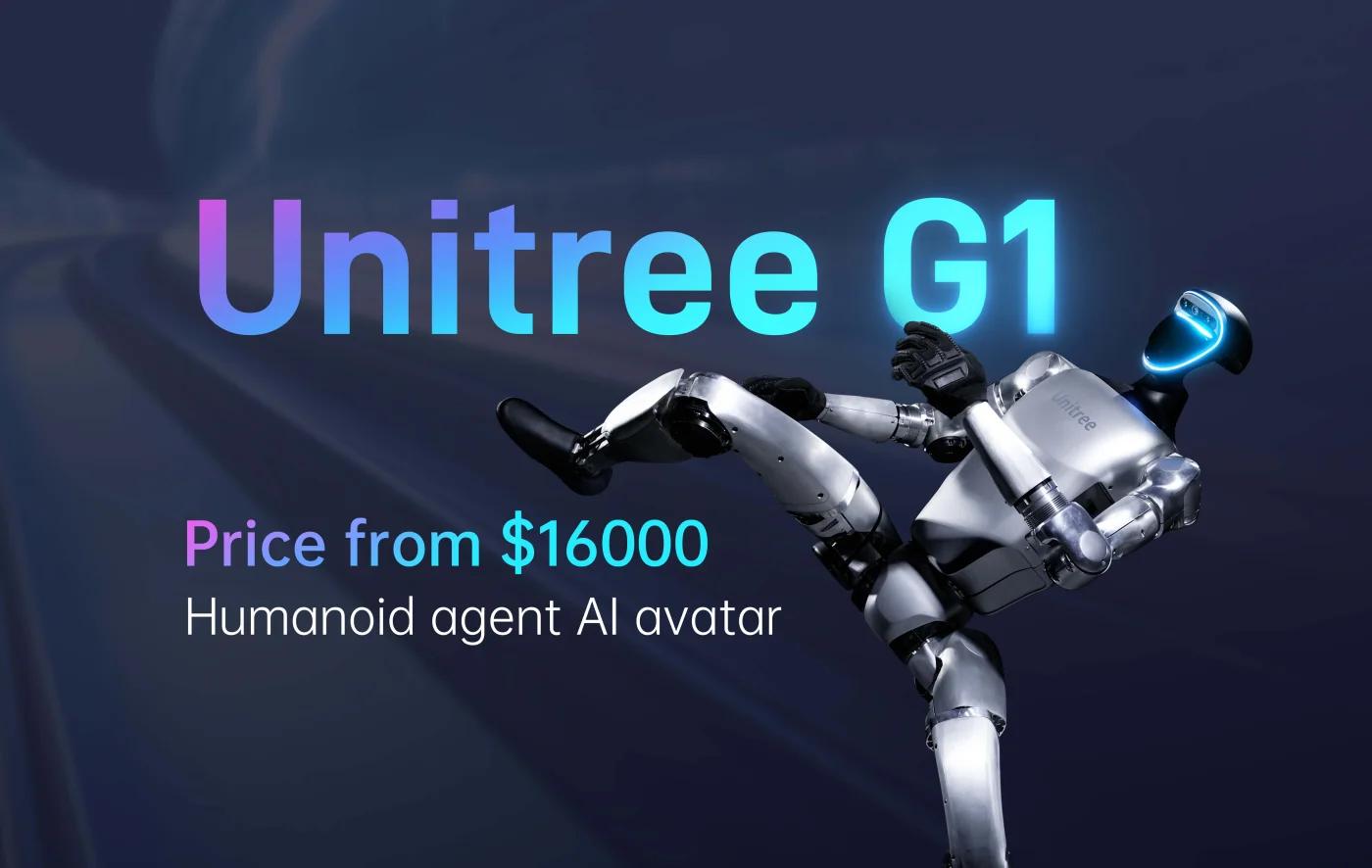
The G1 is Unitree’s previous breakthrough product and remains the best-supported affordable humanoid for buyers who want a more mature platform. The EDU edition ships fully assembled and includes access to Unitree’s simulation and training environment. Unitree publishes no price for the EDU edition and sells it only through its sales team. I track every reported figure, from the $13,500 official base to the research configurations reported above $67,000, in my dedicated Unitree G1 price profile.
Specs at a glance:
• Height: 1.27 m
• Weight: 35 kg
• Degrees of freedom: 43
• Price: $13,500 for the base model on Unitree’s own store; the EDU research edition is contact-sales
• Use case: Developer research, light manipulation tasks
The G1 has more degrees of freedom than the R1, meaning more complex hand and arm movements. It’s been on the market longer, which means a larger developer community and more pre-built task libraries.
3. 1X NEO, $20,000
1X Technologies, backed by OpenAI, is positioning its NEO robot as the first true consumer humanoid. Pre-orders are open at $20,000, with U.S. deliveries beginning in 2026.
Specs at a glance:
• Height: 1.65 m
• Weight: 30 kg
• Designed for: Home use, personal assistance
• Price: $20,000
• Use case: Household tasks, eldercare
NEO is notable because it’s one of the few affordable humanoid robots designed for non-technical end users. The operating interface is built around natural language commands, not robotics programming. Whether it can genuinely perform home tasks at release is the key question, but the intent is a product, not a platform.
4. Tesla Optimus, $20,000 to $30,000 (target)
Tesla has not yet set a firm retail price for Optimus, but Elon Musk has publicly targeted $20,000 to $30,000 per unit. Tesla plans to produce 50,000 units in 2026, scaling toward 1 million annually (Interesting Engineering, 2025).
Optimus is currently deployed internally in Tesla’s own factories. Public availability timelines have shifted before, so treat this as a near-term product rather than a confirmed 2026 purchase.
For context on how Optimus fits into the broader competitive landscape, see the Humanoid Robot Companies 2026: Complete Guide.
Get the Verified Robot Price & Deployment Table (October 2026)
32 humanoid robots. Every price checked against the maker’s own order page or filing, no aggregator numbers, plus the honest deployment status for each. Free PDF, updated monthly. Enter your email and the download link appears right here.
How Fast Are Prices Dropping?
The price drop between 2022 and 2026 is not gradual. It’s a cliff. Goldman Sachs research documented a 40% cost reduction between 2022 and 2023 alone, well ahead of analyst projections. The firm now projects manufacturing costs will fall further to $15,000 to $20,000 per unit at scale (Goldman Sachs Research, 2024).
Unitree’s R1 AIR at $4,900 suggests that Chinese manufacturers have already beaten that target. The gap between the Chinese and Western manufacturers I compare in my complete guide to humanoid robot companies in 2026 is widening fast.
The broader market reflects this acceleration. The global humanoid robot market is projected to grow from $2.92 billion in 2025 to $15.26 billion by 2030, a compound annual growth rate of 39.2% (MarketsandMarkets, 2025). Morgan Stanley projects the total addressable market for humanoid robotics, including downstream services, could reach $5 trillion by 2050 (Morgan Stanley, 2024).
What Can an Affordable Humanoid Robot Actually Do?
This is the honest question most buyers don’t ask clearly enough. The answer depends heavily on which model you buy and whether you have a development team to program it.
Here’s what sub-$30,000 affordable humanoid robots can do in 2026, out of the box or with modest software effort:
Structured pick-and-place tasks: Models with 26 to 43 degrees of freedom can handle object manipulation in controlled environments. Warehouse bins, flat surfaces, and repeatable trajectories are the sweet spot.
Walking and navigation: All models in this price tier can walk autonomously across flat and semi-uneven terrain. Stair navigation is possible on some models but not standard at launch.
SDK-driven custom tasks: Every model in this guide ships with a software development kit. If you have engineers who can write robot operating system (ROS) code or use Unitree’s Python SDK, you can train new behaviors relatively quickly.
AI-assisted command following: The 1X NEO and Tesla Optimus are specifically designed around natural language task input, though field performance at scale remains to be proven.
What they can’t do reliably in 2026: delicate fine motor tasks, open-ended household work in unstructured environments, or anything requiring real-time decision-making in unpredictable spaces. UBTECH reports its industrial humanoids currently operate at 30 to 50% of human productivity on defined factory tasks, with a target of 80% by 2027 (Articsledge, 2025).
Before committing to a pilot, it’s worth reviewing the Are You Ready for Humanoids? 2026 Decision Framework and the 7 Humanoid Deployment Mistakes Manufacturing Leaders Make.
Who Should Buy an Affordable Humanoid Robot Right Now?
Not everyone is ready for a humanoid robot in 2026, even at $4,900. Here’s a straightforward breakdown of who should consider buying now versus waiting.
Buy now if you are:
- A research institution or university lab: The Unitree R1 EDU at $10,500 is a genuine research-grade platform; the cheaper AIR and R1 versions do not support secondary development. If you’re studying locomotion, AI, or human-robot interaction, this is the most accessible entry point in history.
- A manufacturer running a pilot program: If you want to test humanoid robots in a defined task before committing to enterprise-tier models, the Unitree G1 gives you a real platform for $13,500. Pair it with the Step-by-Step Implementation Guide to structure the pilot correctly.
- A robotics startup or AI developer: If you’re building applications on top of humanoid hardware, the sub-$30,000 tier is now the logical development environment.
Wait if you are:
- A home user wanting general domestic help: No affordable humanoid robot in 2026 can reliably handle the unpredictability of home environments. The 1X NEO is promising, but “pre-order” and “early 2026 delivery” means you’re a beta tester, not a customer.
- A manufacturer who needs immediate ROI: At current capability levels (30 to 50% of human productivity), the economics only work in specific, constrained use cases. See the Humanoids vs Cobots comparison to decide whether a humanoid or a cobot makes more sense for your operation.
How Is the China Price War Reshaping the Market?
Unitree’s pricing strategy isn’t accidental. It reflects a deliberate move to dominate the global humanoid robot market before Western manufacturers can reach cost parity.
China’s robotics supply chain is now deeply mature. Servo motors, actuators, sensors, and compute hardware that cost multiples more in the U.S. or Europe are commodity components in Shenzhen. Unitree builds everything in-house, cutting out margins at every tier.
Western manufacturers like Figure, Agility Robotics, and Apptronik are building better robots in some dimensions, more dexterous hands, more sophisticated AI, deeper enterprise support. But they do it at six-figure price points, or without publishing a price at all, which most buyers can’t justify for a first deployment. For a full directory of all manufacturers shipping robots today, including which ones fall under $30,000, see my guide to 40+ humanoid robot companies shaping the market.
The strategic implication: if you’re evaluating affordable humanoid robots for a pilot program, Chinese models like the Unitree R1 and G1 are the cost-efficient entry point. Both hold FCC authorizations granted before July 2026, so the humanoid robot import ban does not remove them from the market, but it does affect which successor models can follow them. Western enterprise models make sense when you need production-grade reliability, regulatory compliance support, or integrated AI systems that Chinese models don’t yet offer.
For a full comparison of all major models across both tiers, see the Humanoid Robot Companies 2026: Complete Guide.
Safety is also a non-trivial consideration in any deployment. The Humanoid Robot Safety Standards 2026 covers what compliance looks like in practice for both research and industrial settings.
Frequently Asked Questions
What is the cheapest humanoid robot you can buy in 2026?
The Unitree R1 AIR at $4,900 is the cheapest humanoid robot with a price published by its maker. It is the entry version of the Unitree R1, a compact 123 cm humanoid; the R1 costs $5,900 and the R1 EDU, the only version that supports secondary development, $10,500 (Unitree store, checked 30 September 2026). Before the R1 launched in July 2025, the Unitree G1, then listed at $16,000, held that record (Robotics and Automation News, 2025). For a complete purchasing guide covering availability, shipping, and sourcing options, see my humanoid robots for sale buyers guide.
Are affordable humanoid robots ready for home use?
Not reliably in 2026. The 1X NEO ($20,000) is the closest to a home-ready product, but it’s still in early delivery phase. Home environments, unstructured, unpredictable, full of exceptions, remain harder for humanoid robots than factory tasks. Expect genuine home capability from consumer robots in the 2027 to 2028 window.
How fast are humanoid robot prices dropping?
Quickly. Goldman Sachs documented a 40% cost reduction between 2022 and 2023, ahead of projections. At that rate, Goldman now projects prices could fall to $15,000 to $20,000 per unit at scale. Unitree’s R1 AIR at $4,900 suggests the most aggressive manufacturers are already there (Goldman Sachs Research, 2024).
What’s the difference between Unitree R1 and Unitree G1?
The G1 ($13,500) has up to 43 degrees of freedom versus 20 to 26 on the R1, meaning more complex manipulation capability. The G1 also has a larger developer community since it launched earlier. The R1 is lighter (about 29 kg vs 35 kg) and significantly cheaper, from $4,900 for the R1 AIR and $5,900 for the R1. For basic research tasks, the $10,500 R1 EDU is sufficient, since only that version supports secondary development. For complex manipulation work, the G1 is the better choice.
Will Tesla Optimus be affordable?
Tesla has targeted a $20,000 to $30,000 price point for Optimus, with plans to produce 50,000 units in 2026. That would put it firmly in the affordable humanoid category. However, timelines have shifted before, and confirmed retail availability has not yet been announced (Interesting Engineering, 2025).
Sources
- Unitree Robotics, Unitree R1 product page (R1 AIR, R1, R1 EDU prices), checked 30 September 2026. https://shop.unitree.com/products/unitree-r1
- Robotics and Automation News. https://roboticsandautomationnews.com/2025/07/29/shock-price-unitree-launches-5900-humanoid-robot/93357/
- MarketsandMarkets. https://www.globenewswire.com/news-release/2025/07/25/3121784/0/en/Humanoid-Robot-Market-Set-for-15-26-Billion-Growth-by-2030-Discover-Future-of-Advanced-Robotics.html
- Goldman Sachs Research. https://www.goldmansachs.com/insights/articles/the-global-market-for-robots-could-reach-38-billion-by-2035
- Interesting Engineering. https://interestingengineering.com/culture/can-optimus-make-america-win
- Morgan Stanley. https://www.morganstanley.com/insights/articles/humanoid-robot-market-5-trillion-by-2050
- Articsledge. https://www.articsledge.com/post/humanoid-robots-business

Ulrich Baldauf is the founder of There’s A Robot For That, covering humanoid robotics for manufacturing and industrial operations. He has tracked the humanoid robot sector since 2024, with a focus on safety standards (ISO 10218, EU Machinery Regulation 2023/1230) and what deployments mean for operations and EHS teams. Connect on LinkedIn: linkedin.com/in/ubaldauf