

Key Takeaways
- The Unitree R1 price on Unitree’s own store is $4,900 for the R1 AIR, $5,900 for the R1 and $10,500 for the R1 EDU, all in stock (checked October 24, 2026).
- Those prices exclude tax and shipping. Unitree’s store quotes shipping at $300 to $1,200 and leaves customs duties and import clearance to the buyer.
- Only the R1 EDU is open for programming (“secondary development”) and can take dexterous hands and an extra compute module. The AIR and the standard R1 cannot.
- Prices depend on where you buy. The South China Morning Post reported a domestic entry price of 29,900 yuan in April 2026, and Bloomberg reported about $8,150 for the R1 on AliExpress with import fees included.
- The R1 is a demo and education platform: about one hour of battery, about 2 kg of arm load, and no verified customer deployment on record in the Humanoid Reality Index.
The Unitree R1 costs $4,900, $5,900 or $10,500, depending on which of its three versions you buy. Those are the prices Unitree lists on its own store for the R1 AIR, the R1 and the R1 EDU, before tax and shipping, and all three were in stock when I checked on October 24, 2026. The bigger question is which version you actually need, because the $4,900 AIR cannot be programmed and the EDU costs more than twice as much.
This page breaks down what each R1 version includes, what you pay on top of the list price, how the price differs between Unitree’s store, AliExpress and China, how the R1 compares with Unitree’s larger G1, and what the robot can and cannot do once it arrives. Every price is checked on Unitree’s own pages, and every other figure links to its source.
Table of Contents
What Is the Unitree R1 Price in 2026?
The Unitree R1 price starts at $4,900 for the R1 AIR and rises to $10,500 for the R1 EDU. The R1 product page in Unitree’s store lists six variants, each version in white or red, and marks all of them as available. The R1 page on unitree.com shows the same two lower prices under the heading “Tax and Shipping cost excluded”.
| Version | Price (Unitree store) | Joints | Warranty |
|---|---|---|---|
| R1 AIR | $4,900 | 20 | 6 months |
| R1 | $5,900 | 26 | 8 months |
| R1 EDU | $10,500 (store); “Contact Sales” on unitree.com | 26 to 40 | 12 months |
Two details matter before you budget. First, the list price is not what lands on your floor. Unitree’s store states that “Shipping costs between $300 and $1200” and that the customer is responsible for customs duties, taxes and import clearance. Second, the R1 EDU has two answers. Unitree’s store sells it for $10,500, while the comparison table on unitree.com shows “Contact Sales” for the same version. If you need an EDU with hands or extra compute, expect the configured price to come from a sales conversation rather than the cart.
Unitree sells the R1 humanoid robot in three versions on its own store: the R1 AIR at $4,900, the R1 at $5,900 and the programmable R1 EDU at $10,500, excluding tax, with shipping quoted at $300 to $1,200 and customs duties paid by the buyer.
R1 AIR, R1 or R1 EDU: Which Version Do You Need?
Buy the R1 EDU if you want to write your own software for the robot, the standard R1 if you want the full body for demos, and the AIR only if a fixed-function showpiece is enough. That is the practical reading of Unitree’s own specification table, which differs between the versions in four places that matter.
- Joints. The AIR has 20 joints: six per leg and four per arm, with no waist or head joints. The R1 adds a fifth arm joint, two waist joints and two head joints for 26. The EDU starts at 26 and goes up to 40 with optional dexterous hands, the only version that can take hands at all.
- Vision. The AIR has a monocular camera. The R1 and the EDU have a binocular camera, which gives depth perception.
- Programming. Unitree marks “Secondary Development” as available only for the EDU. The AIR and the standard R1 run Unitree’s own behaviors and receive over-the-air updates, but they are not offered for custom development.
- Compute and warranty. All three run on an 8-core processor. Only the EDU can add a high-power computing module, which Unitree describes as available in “multiple brands and models”, such as Nvidia Orin at 40 to 100 TOPS. Warranty grows with the price: 6, 8 and 12 months.
The jump from R1 to EDU, $4,600, buys programmability, a longer warranty and the option to add hands and compute. The hands and the compute module are not sold as store variants, so they are priced separately. For a school, a lab or a developer, that jump is the whole point of the purchase. For a trade-show demo, it is money you do not need to spend.
Where Can You Buy a Unitree R1, and What Does It Cost There?
You can buy the R1 directly from Unitree’s online store, through Unitree’s listing on AliExpress, or in China through domestic channels, and each route quotes a different number for a different bundle of costs. The table compares them, with the type of each price spelled out, because these figures are not interchangeable.
| Buying route | Price | What the price covers | Source |
|---|---|---|---|
| Unitree online store | $4,900 / $5,900 / $10,500 | Manufacturer list price, robot only. Shipping $300 to $1,200 extra; duties and taxes paid by the buyer | Unitree store, checked October 24, 2026 |
| AliExpress (Unitree listing) | About $8,150 (R1); about $6,800 (scaled-down version) | Reported at launch with import fees included and free shipping to the US | Bloomberg, April 15, 2026 |
| China, domestic | From 29,900 yuan | Domestic starting price, not available to international buyers at that level | South China Morning Post, April 2026 |
The AliExpress route looks more expensive, but the comparison is not like for like. Bloomberg reported, citing Unitree, that the R1 “will cost roughly $8,150 with import fees factored in, and shipping to the US will be free of charge”, with a scaled-down version at about $6,800, sold to markets including the US, Canada, Japan, the United Arab Emirates and Singapore. The store price of $5,900 plus up to $1,200 shipping already reaches $7,100 before duties, so compare total landed cost for your country, not list prices.
The domestic Chinese price is a trap for comparisons. At the European Central Bank reference rate of 6.6702 yuan per dollar on October 23, 2026, 29,900 yuan is about $4,480, close to the AIR’s US list price. That number is the price for buyers in China, not a discount international buyers can reach.
Get the Verified Robot Price & Deployment Table (October 2026)
32 humanoid robots. Every price checked against the maker’s own order page or filing, no aggregator numbers, plus the honest deployment status for each. Free PDF, updated monthly. Enter your email and the download link appears right here.
How Has the Unitree R1 Price Changed Since Launch?
The entry price for the R1 line fell in China and has held steady on Unitree’s online store. Unitree launched the R1 on July 25, 2025 “at a starting price of 39,900 yuan ($5,566)”, according to Reuters, which noted that the G1 had launched in 2024 at 99,000 yuan. By April 2026, when Unitree began selling the R1 on AliExpress, the domestic entry price was 29,900 yuan, as the South China Morning Post reported. Neither report says which version the lower figure buys. Since the launch, Unitree has split the R1 into three versions, so the drop may reflect a cheaper entry version as much as a cut on the same robot.
On Unitree’s online store, nothing has moved in the period I have tracked. The Humanoid Reality Index entry for the R1 recorded $4,900, $5,900 and $10,500 on August 2, 2026, and the store showed the same three prices on October 24, 2026. My humanoid robot price tracker follows every maker-published price in the Humanoid Reality Index.
The chart below places the three R1 versions next to the Unitree G1, the next model up in Unitree’s range.
What Can the Unitree R1 Actually Do?
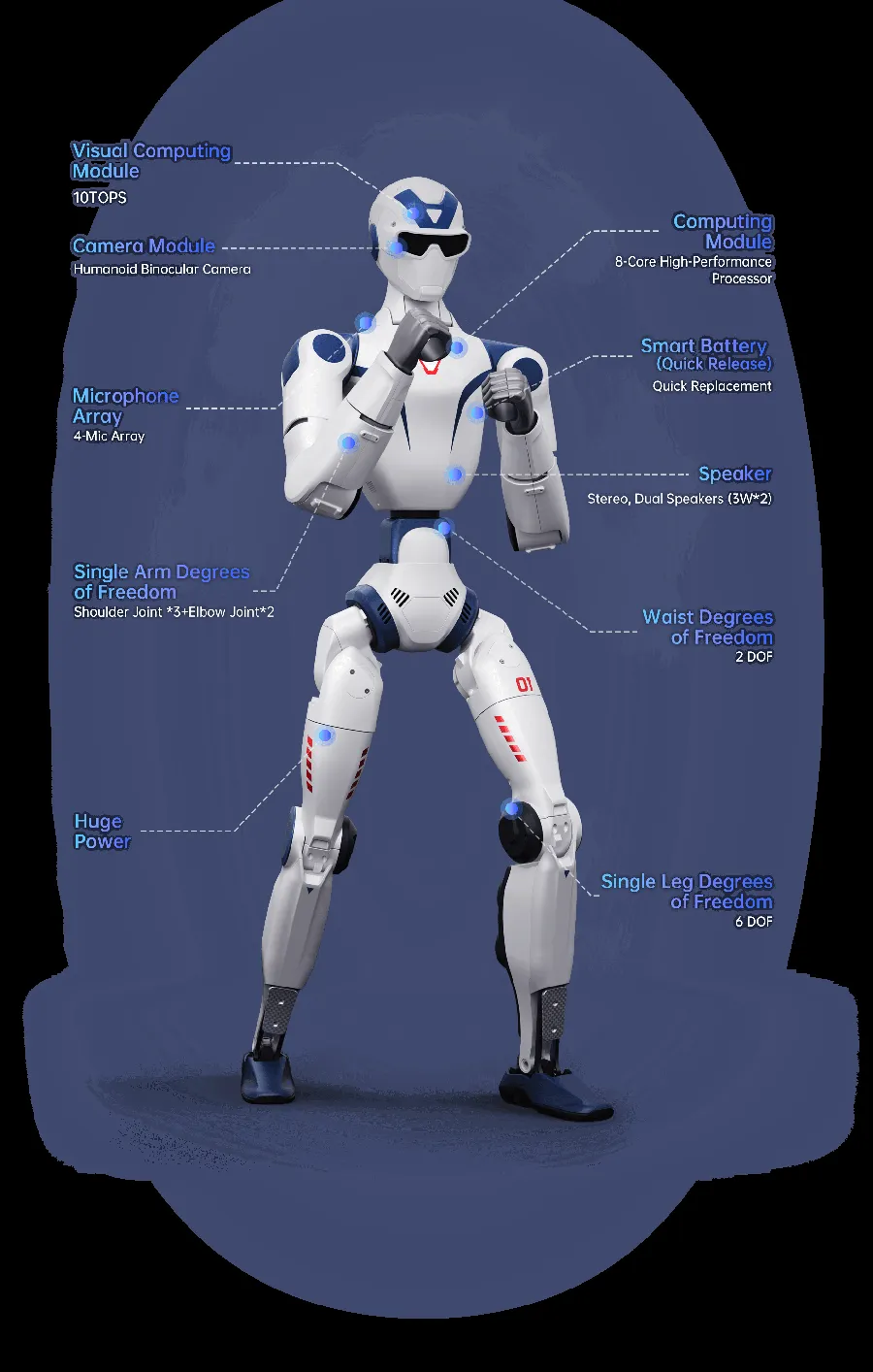
The R1 walks and balances, listens through a four-microphone array and answers through its speaker, using what Reuters described in its launch report as a multimodal large language model integrating speech and image. It is not built to carry loads or work a shift. These are the figures Unitree publishes on its R1 product page.
| Specification | Unitree R1 (all versions unless noted) |
|---|---|
| Height, standing | 1,230 mm (about 4 ft) |
| Weight with battery | About 27 kg (AIR), about 29 kg (R1, EDU) |
| Arm load | About 2 kg; Unitree notes it “varies greatly under different arm extension postures” |
| Battery | Quick-release smart battery, about 1 hour per charge |
| Compute | 8-core processor; EDU can add a high-power module such as Nvidia Orin (40 to 100 TOPS) |
| Sensing and audio | Monocular camera (AIR) or binocular camera (R1, EDU); 4-microphone array; speaker |
| Connectivity | Wi-Fi 6, Bluetooth 5.2; over-the-air updates |
| Included | Battery, charger, manual controller |
Two lines in that table define what the R1 is for. An hour of battery rules out shift work, and an arm load of about 2 kg rules out most handling tasks. Unitree itself is direct about the limits. Its product page warns that “Individual users are strongly advised to thoroughly understand the limitations of humanoid robots before making a purchase”, asks users to “maintain a sufficient safety distance from the robot at all times”, and describes the R1 as “a civilian robot”.
The clearest announced buyer use is education. In July 2026, the US education company iCode announced that R1 EDU robots would arrive at 16 of its campuses for a high-school program. That is an announcement by the buyer, not an independent deployment report. The Humanoid Reality Index rates the R1 Tier 3, Demoing: demos and claims, with no verified customer deployment on record.
How Does the R1 Compare With the Unitree G1?
The G1 costs more than twice as much as the standard R1 and buys you a bigger body and double the battery life, not more arm strength. Both robots list the same arm load of about 2 kg. The G1 figures below come from Unitree’s G1 product page as recorded in the Humanoid Reality Index on July 30, 2026.
| Feature | Unitree R1 | Unitree G1 |
|---|---|---|
| List price (Unitree online store) | $4,900 to $10,500 | $13,500 |
| Height | 1,230 mm | 1,320 mm |
| Weight | About 27 to 29 kg | About 35 kg |
| Joints (base model) | 20 (AIR) or 26 (R1) | 23 |
| Arm load | About 2 kg | About 2 kg |
| Battery life | About 1 hour | About 2 hours |
The R1 EDU costs $3,000 less than a base G1 and is the R1 version Unitree opens for programming. The G1 gives you a larger body and twice the runtime per charge. My Unitree G1 price guide covers the G1’s versions and costs, and the Unitree G1 review covers what it does in practice.
Is the Unitree R1 Worth the Money?
For education, research groups on a budget and demonstrations, yes. For household chores or factory work, no. Its battery, arm load and lack of hands outside the EDU put real work out of reach, and Unitree’s own warnings say as much.
Where the R1 earns its price is as an entry ticket. At $5,900 for the full-body R1, or $10,500 for a version you can program, the three standard versions can be ordered from the maker’s online store at a published price, without a sales call, while most humanoids in my guide to humanoid robots for sale have no published price at all. That makes it a sound purchase for teaching robotics, for testing motion software and for public-facing demos, as long as you plan for shipping, duties and a one-hour duty cycle. If you are comparing it with other robots in the same price band, my affordable humanoid robots buyer’s guide lists the alternatives with their buying paths.
Frequently Asked Questions
How much does the Unitree R1 cost?
On Unitree’s own store the R1 AIR costs $4,900, the R1 $5,900 and the R1 EDU $10,500, excluding tax (checked October 24, 2026). Shipping adds $300 to $1,200, and the buyer pays customs duties and import taxes.
Can you buy the Unitree R1 in the US?
Yes. Unitree has sold the R1 to the US through AliExpress since April 2026, at about $8,150 for the R1 with import fees included and free shipping, according to Bloomberg. Its online store listed all three versions in stock on October 24, 2026.
What is the difference between the R1 AIR and the R1?
The AIR has 20 joints, no waist or head movement, a monocular camera and a 6-month warranty. The R1 has 26 joints, including two in the waist and two in the head, a binocular camera for depth perception and an 8-month warranty, for $1,000 more.
Can you program the Unitree R1?
Only the R1 EDU. Unitree lists “Secondary Development” as available for the EDU and not for the AIR or the standard R1, which run Unitree’s own behaviors and receive over-the-air updates.
How long does the Unitree R1 battery last?
About one hour per charge, according to Unitree. The battery is a quick-release pack, so a swap rather than a recharge is possible if you have a second pack.
Does the Unitree R1 have hands?
Not as standard. Dexterous hands are an option only on the R1 EDU, which goes from 26 to as many as 40 joints with hands fitted.
Is the Unitree R1 cheaper in China?
A domestic entry price of 29,900 yuan was reported by the South China Morning Post in April 2026. That converts to about $4,480, but it is a domestic price for an unspecified version and not available to buyers outside China, who pay Unitree’s online store price of $4,900 and up, before tax, shipping and duties.
Sources
- Unitree Robotics, Unitree R1 store page (prices of all six variants, stock status, shipping and duties note; checked October 24, 2026)
- Unitree Robotics, Unitree R1 product page (specification table, version differences, warranty, safety notes; checked October 24, 2026)
- Reuters, China’s Unitree prices new humanoid robot at deep discount to 2024 model, July 25, 2025
- Bloomberg, Tesla’s Chinese Robot Rival Ramps up Global Push Ahead of IPO, April 15, 2026
- South China Morning Post, China’s Unitree to debut cheapest humanoid robot globally on Alibaba site, April 2026
- iCode via EIN Presswire, iCode Bringing Unitree R1 EDU Humanoid Robots to 16 Campuses for New Youth Innovation Program, July 24, 2026
- European Central Bank, euro foreign exchange reference rates, October 23, 2026 (yuan per dollar derived from the CNY and USD rates)
- There’s A Robot For That, Humanoid Reality Index: Unitree R1 and Unitree G1 (audited prices, tier and specifications)
Last verified October 24, 2026. Unitree’s store and product page were fetched directly that day; figures from news coverage are dated to their publication.

Ulrich Baldauf is the founder of There’s A Robot For That, covering humanoid robotics for manufacturing and industrial operations. He has tracked the humanoid robot sector since 2024, with a focus on safety standards (ISO 10218, EU Machinery Regulation 2023/1230) and what deployments mean for operations and EHS teams. Connect on LinkedIn: linkedin.com/in/ubaldauf